

Will milling wheat cost more, less or the same in three months?
An example miller buys wheat three months ahead. Euronext milling wheat settled at EUR 233.50 per tonne on 13 November 2026; where it stands on 12 February 2027 sets the margin.
Short answer
Most likely: scenario B, the price stays near EUR 233.50 per tonne. 5 of 12 signals point there, 4 point to scenario C (higher price) and 3 to scenario A (lower price). This is a share of signals, not a statistical chance.
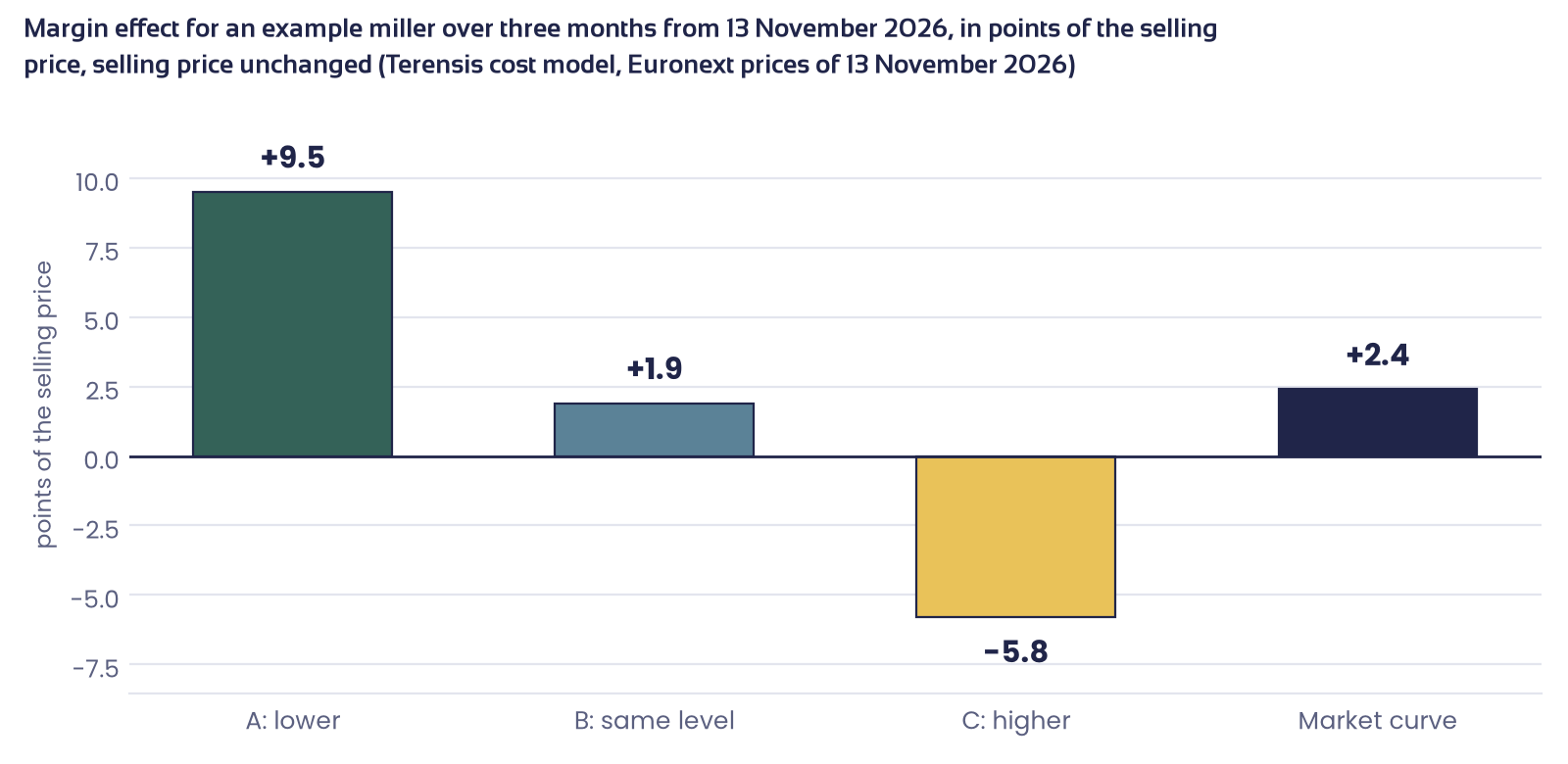
For an example miller with a three-month cover, today's price is 2.6% below the wheat cost already in the selling price, so an unchanged market lifts the margin by 1.9 points if the selling price stays. A move of one standard step, about EUR 26 per tonne, would give +9.5 points (lower) or -5.8 points (higher).
Only one signal separates scenario B from scenario C. The next releases that can break the tie are the USDA world balance on 10 December 2026 and the next Algerian wheat tender.
Three scenarios for the Euronext milling wheat price on 12 February 2027
Share of signals, not a statistical chance. Prices: Euronext settlement of the December 2026 contract on 13 November 2026 (EUR 233.50), plus or minus one standard step of 11.15%. Margin effect in points of the selling price for an example miller, selling price unchanged. Illustrative cost structure.
Read the full Margin Call
Leave your email address to read the scenarios in detail, the evidence behind every signal and the cost model, and to download the PDF.
We use your email address to give you access and to follow up on this Margin Call. You can object at any time. More in our privacy policy.
1. Which scenario is most realistic?
Of the 12 signals with a current reading, 5 point to scenario B (same price), 4 to scenario C (higher price) and 3 to scenario A (lower price), on readings to 13 November 2026. Signals marked as our reading are judgement; the others follow the direction the data states. Two tiles are context and not counted: a seasonal pattern of other years, and a trading-desk view.



Euronext, CFTC, USDA, COCERAL, FranceAgriMer, ECMWF, European Commission, ECB and Commodity3, readings to 13 November 2026.
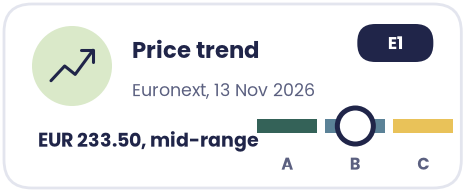
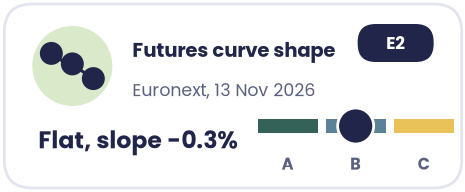
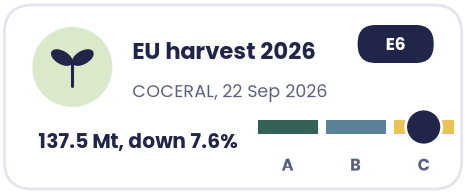
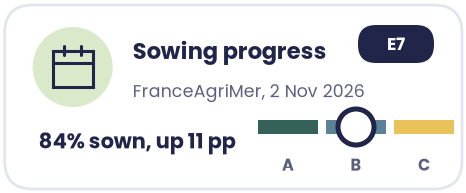
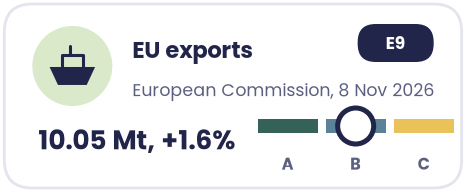
Why scenario B leads. The price sits between its 20-day average (EUR 230.43) and 50-day average (EUR 237.00) and the curve is flat, the physical basis at Rouen is normal, EU exports run 1.6% above the same weeks of 2025/26 and French sowing is ahead of the average. Against that, the world balance, funds and cheap Chicago wheat lean down (3 signals), and the weak euro, the dry autumn in Russia, France and Poland, the smaller 2026 EU harvest and large importer purchases lean up (4 signals).
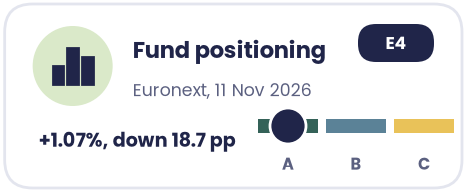
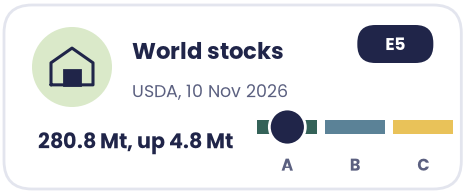
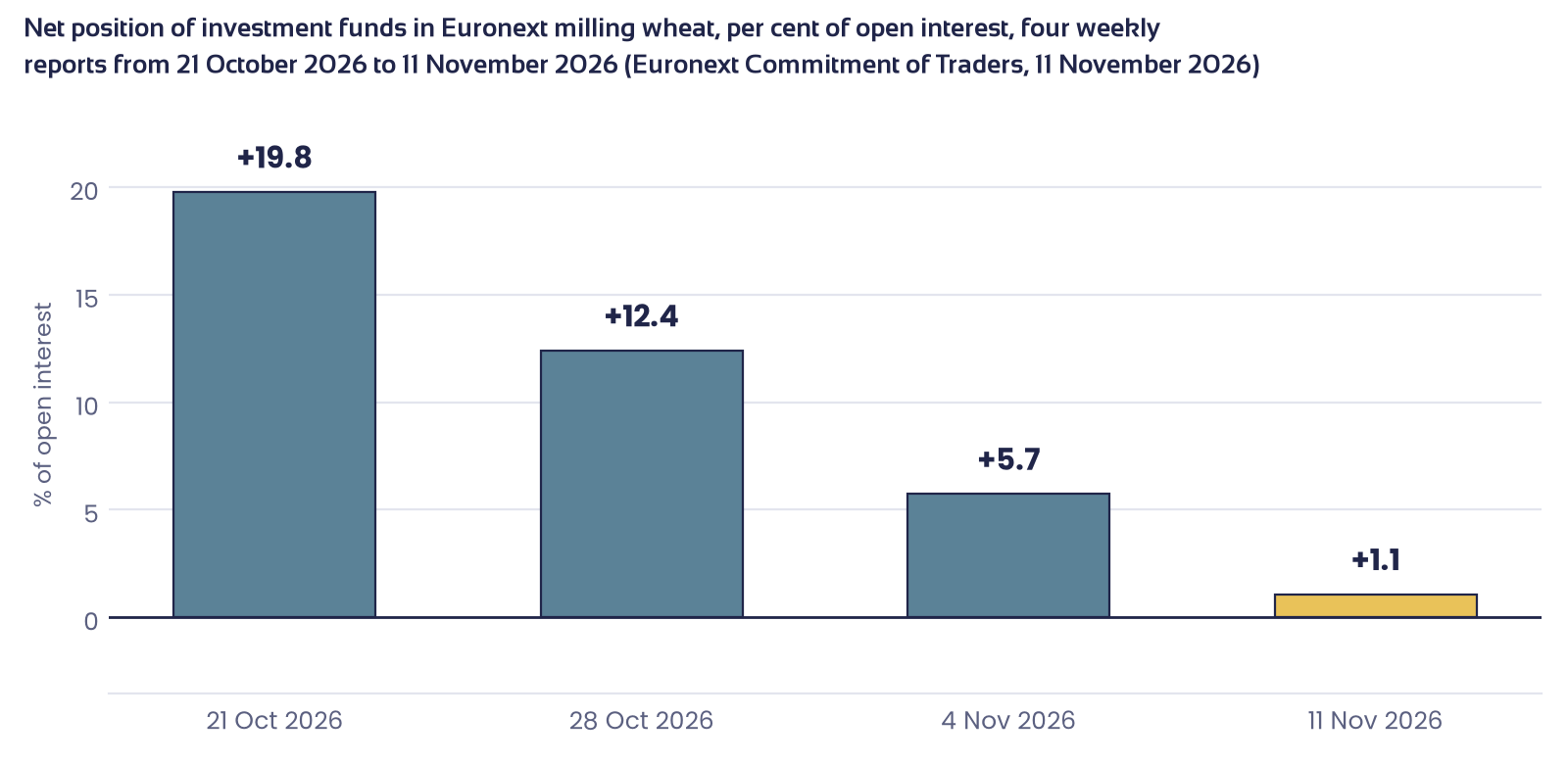
What the headline hides. World ending stocks of 280.8 Mt include China and Black Sea stocks that do not reach the export market. The Algerian price of about USD 313 per tonne includes freight and is a single trade estimate. Euronext funds look flat at 1.07% net long, but they cut 18.7 points in three weeks.
What would break the tie. Scenario B leads scenario C by one signal. A rise of world stocks above 280.8 Mt in the USDA report of 10 December 2026 would add weight to scenario A; a cut of the stocks figure or a second large Algerian purchase at a similar premium to Rouen FOB would add weight to scenario C.
| Who | View | Compared with scenario B |
|---|---|---|
| Walsh Trading (trading desk), via Barchart, 13 November 2026 | Wheat is coming off eight-month lows and was deeply oversold; Black Sea attacks ramped up again after the Abu Dhabi talks failed. No price level is given and the comment is about Chicago wheat. | Differs: points to scenario C (higher price) |
Other market participants, context and not counted: Barchart, 13 November 2026.
2. How do the other scenarios answer it?
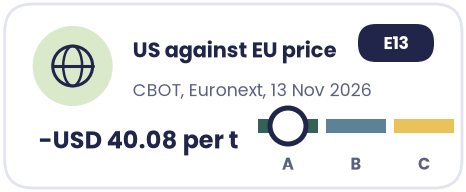
- Scenario A: lower price (3 of 12 signals). USDA raised world ending stocks by 4.8 Mt to 280.8 Mt on 10 November 2026, funds cut Euronext net length from 19.77% to 1.07% of open interest in three weeks, and Chicago soft red winter wheat is USD 40.08 per tonne below Euronext, the 15th percentile of 10.2 years. Scenario A needs Euronext to close that difference from above: Southern Hemisphere harvests (Argentina 23.0 Mt, Australia 32.5 Mt, both raised by USDA) and a quiet Black Sea would do it. It is confirmed if the nearest contract settles at or below about EUR 207 per tonne on 12 February 2027.
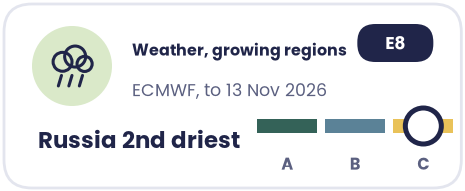
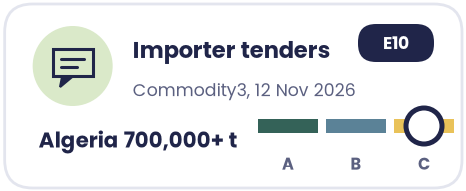
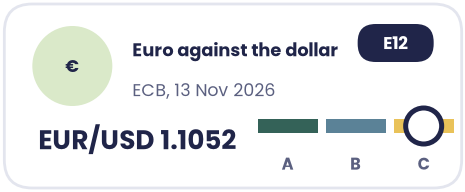
- Scenario C: higher price (4 of 12 signals). Russian winter wheat areas had 38.1 mm of rain from 1 October 2026 to 13 November 2026, the second driest autumn of 30 years, the dollar is at its strongest against the euro in 52 weeks (EUR/USD 1.1052), the 2026 EU soft wheat crop is 7.6% smaller than the previous season and Algeria bought more than 700,000 t at about USD 313 per tonne including freight. Scenario C needs the Black Sea to stay restricted and the dry autumn to carry into spring. It is confirmed if the nearest contract settles at or above about EUR 260 per tonne on 12 February 2027.
Winter wheat is dormant or just emerging in November 2026, so the weather signal is a risk to crop establishment, not a yield loss. Analogue seasons, the past years that ran like this one, can only be matched from March 2027.
3. What do the scenarios mean for margin?
Base
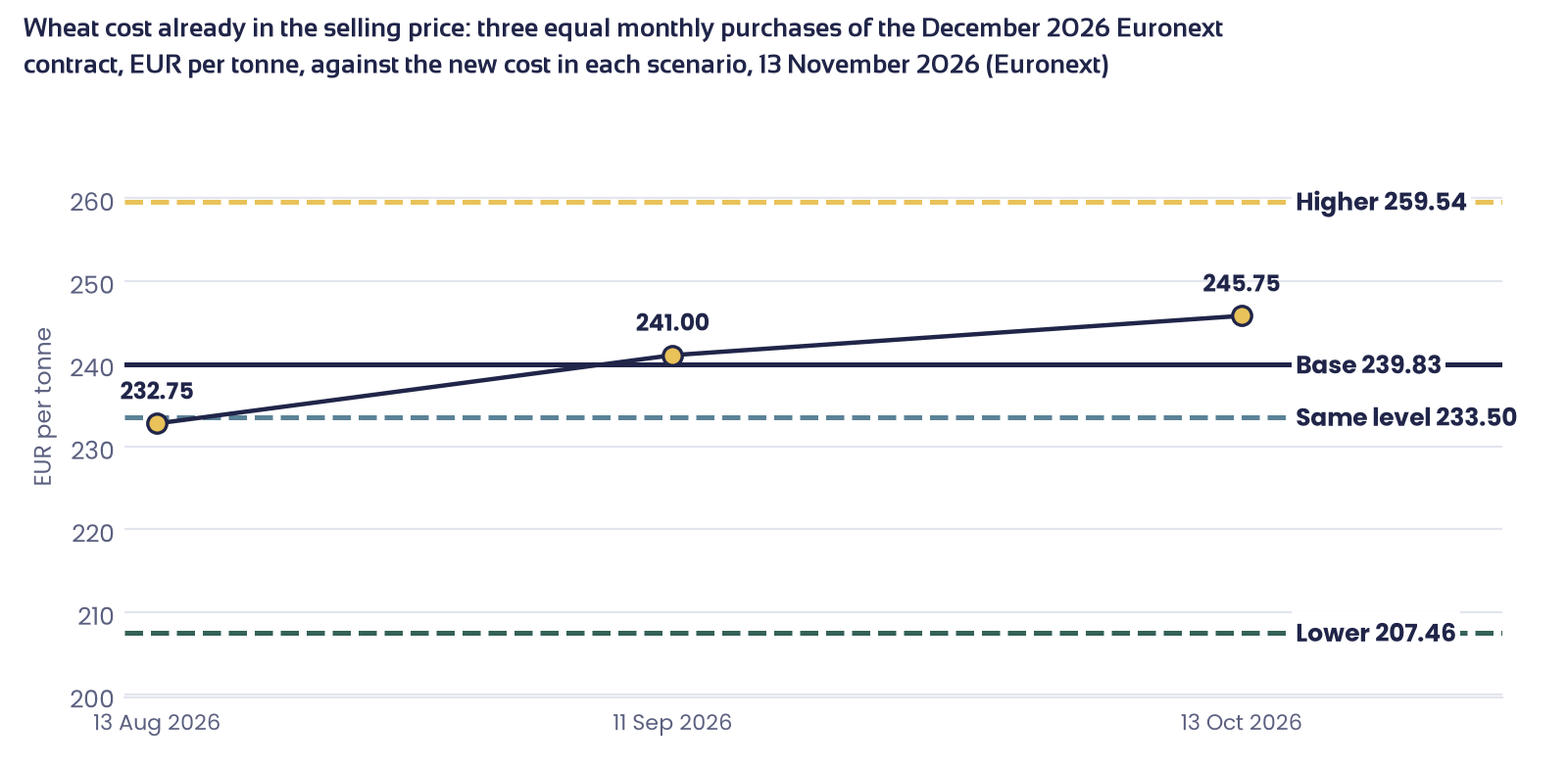
Base: the wheat cost that is already in the selling price today. It is the average price of equal monthly purchases from 13 August 2026 to 13 November 2026. How to read the numbers: "-2.0" means that of every EUR 100 of sales, EUR 2 less stays as margin. "+1.0" means EUR 1 more stays. The selling price is assumed unchanged.
| Scenario | Wheat price assumed, EUR per tonne | Change in wheat cost against the base | Margin effect, points of the selling price |
|---|---|---|---|
| A Lower | 207.46 (one standard step below) | -13.5% | +9.5 |
| B Same level | 233.50 (settlement of 13 November 2026) | -2.6% | +1.9 |
| C Higher | 259.54 (one standard step above) | +8.2% | -5.8 |
| Market curve | 231.50 (December 2026 and March 2027 contracts) | -3.5% | +2.4 |
Terensis cost model for an example miller (wheat 70% of the price, other costs 30%), Euronext prices of 13 November 2026. Illustrative.
The base cost is EUR 239.83 per tonne: three equal monthly purchases of the December 2026 contract at EUR 232.75 (13 August 2026), EUR 241.00 (11 September 2026) and EUR 245.75 (13 October 2026). Today's price of EUR 233.50 is EUR 6.33 below it, so even an unchanged market lowers the wheat cost by 2.6%.
One standard step is the typical size of price swings over the cover period: 22.3% a year for the stored-crop contracts over the 20 days to 13 November 2026, times the square root of 3/12, gives 11.15%, or EUR 26.04 per tonne on EUR 233.50. This is a fixed rule, not a forecast. Only the wheat price moves; energy, freight, labour, packaging and margin stay at today's level. The market curve line (December 2026 and March 2027 contracts) is shown because it differs from scenario B by more than 0.5 points.
4. What should I do now?
Scenario B is the most realistic, but only one signal separates it from scenario C and a move of one standard step in three months is normal for this market. These are options to weigh, not advice.
Price levels that change the call
Open questions the market has not answered yet
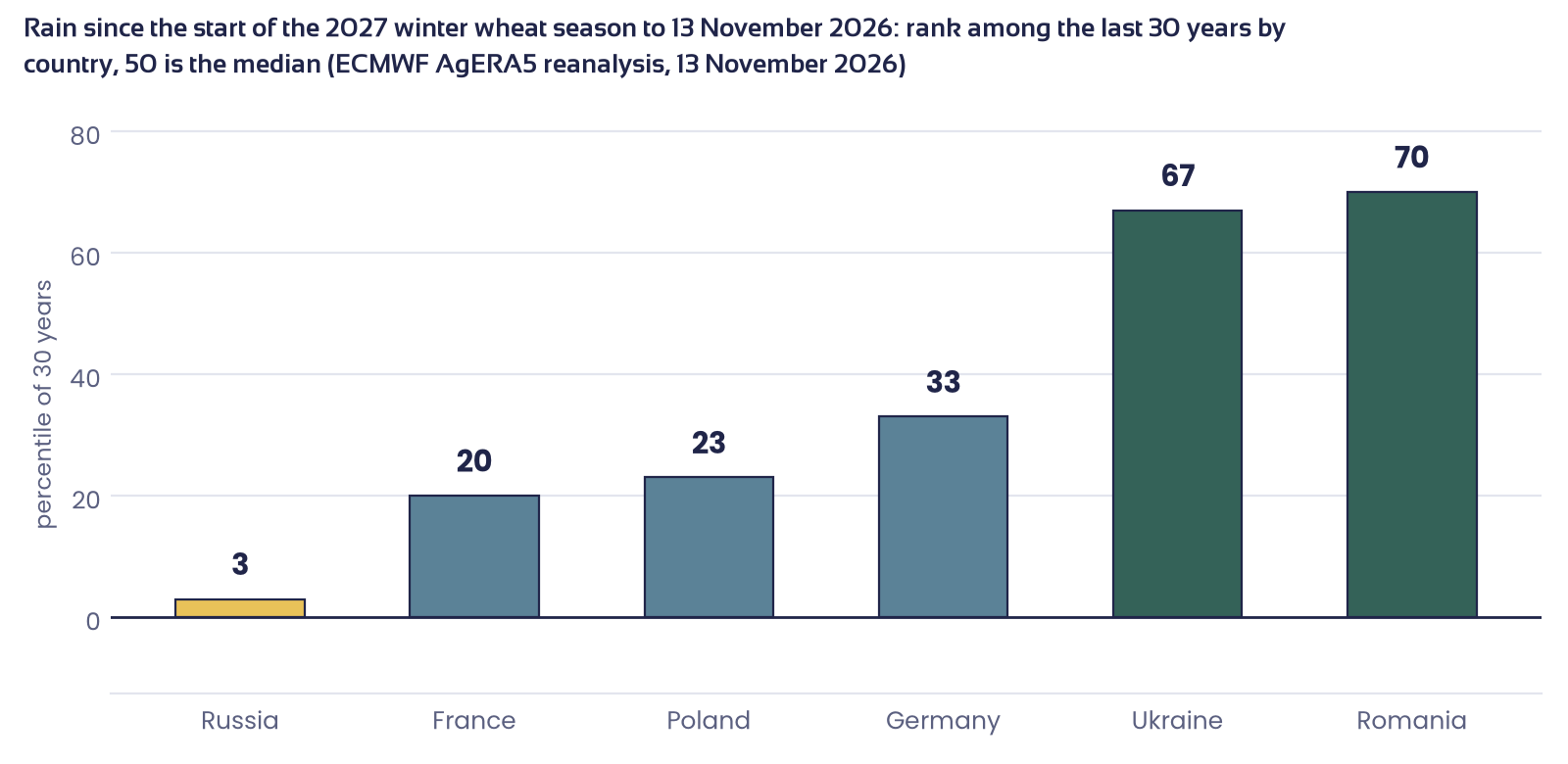
- Will Russian winter rain recover? Rain was at the 3rd percentile from 1 October 2026 to 13 November 2026. The JRC MARS bulletin expected by 4 December 2026 and winter rain until 12 February 2027 will show it.
- Is Algeria's purchase the start of a trend? The next Algerian tender: its price against Rouen FOB and its volume against 700,000 t.
- Will USDA raise world stocks again? The USDA report of 10 December 2026 (projected date) against 280.8 Mt.
- Will the euro stay weak against the dollar? EUR/USD at 1.1052 supports Euronext; a move back above 1.12 would remove the support.
| Date | Release | Signals it can change | What would change the call |
|---|---|---|---|
| 16 November 2026 | USDA Crop Progress (confirmed) | E7 Sowing progress | US winter wheat rated below 49% good or excellent would add weight to scenario C; above 49% eases the US crop concern and supports scenario A. |
| 25 November 2026 | US PCE inflation (confirmed) | E12 Euro against the dollar | A print above 0.278% a month (past Euronext moves -0.33% on average, 54 releases) or below 0.16% (+0.11%, 43 releases) has shown no reliable effect; only a lasting move of the euro changes E12. |
| 4 December 2026 | JRC MARS bulletin (expected by this date) | E7 Sowing progress, E8 Weather | Low soil moisture confirmed for French or German winter wheat adds weight to scenario C; recovered moisture adds weight to scenario B. |
| 10 December 2026 | USDA WASDE (projected date) | E5 World stocks, E6 EU harvest | World ending stocks above 280.8 Mt add weight to scenario A (stocks were materially revised in 4 of 10 past years, 30% up and 10% down); a cut below 280.8 Mt moves E5 to scenario C. |
Upcoming releases that can change the call: Terensis release calendar read on 14 November 2026 (USDA, ECB and BEA schedules; JRC MARS date is an upper bound).
5. Evidence
| Evidence | Reading | Source and date | Points to |
|---|---|---|---|
| E1 Price trend ↑ | Our reading: Euronext milling wheat settled at EUR 233.50 per tonne on 13 November 2026, between its 20-day average (EUR 230.43) and its 50-day average (EUR 237.00) and above its 200-day average (EUR 215.35). It rose 3.5% in the week, fell 5.2% in the month and is 22.7% above a year ago; 52-week range EUR 179.75 (11 May 2026) to EUR 249.75 (2 September 2026). A price between its averages without a trend points to an unchanged price. | Euronext, settled 13 November 2026 | B Same level |
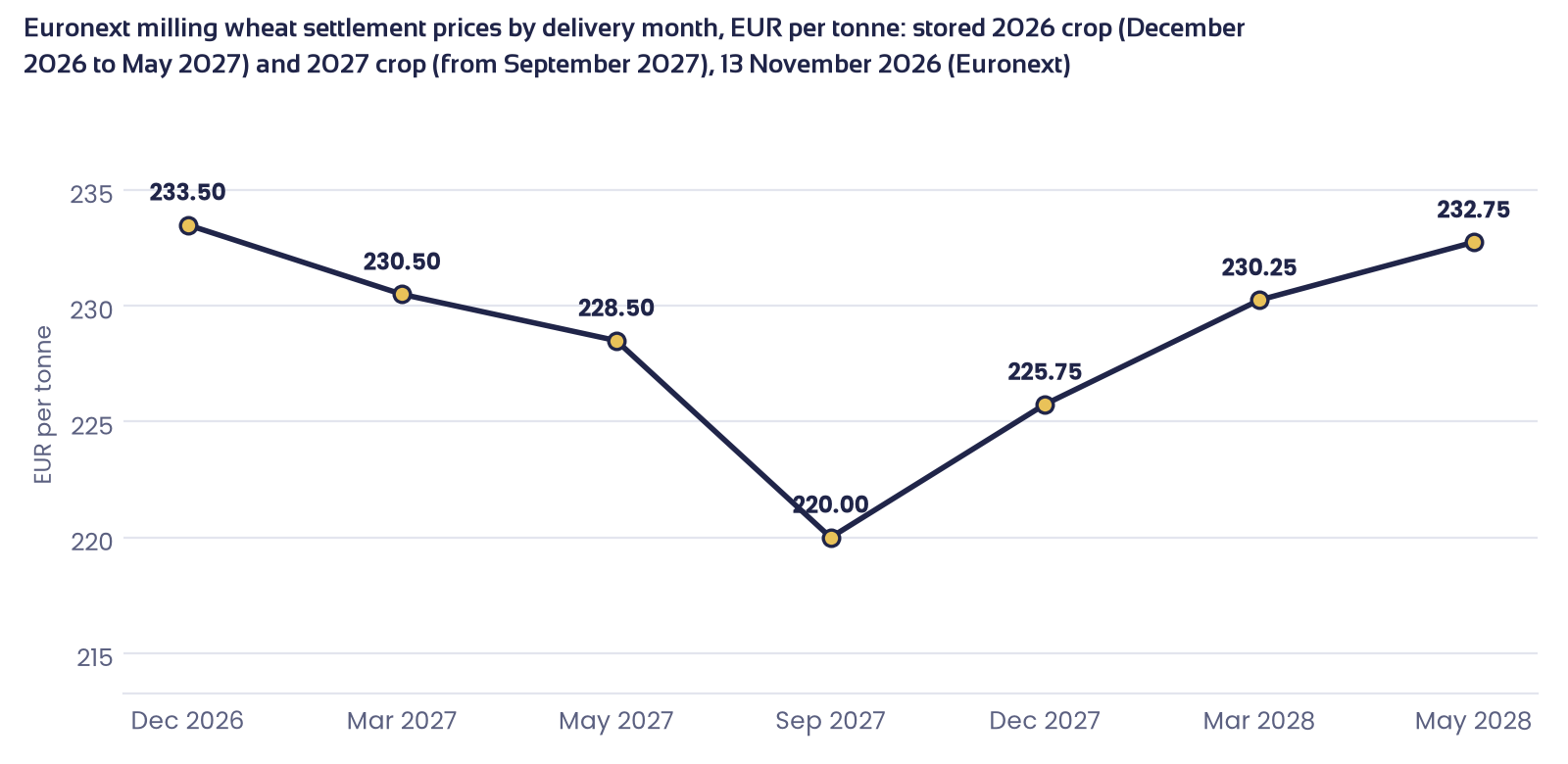
| E2 Shape of the futures curve ↑ | Prices for later months are slightly lower than for nearby months: December 2026 EUR 233.50, March 2027 EUR 230.50, May 2027 EUR 228.50, September 2027 EUR 220.00. The slope from the nearest to the furthest contract is -0.3%, which reads as flat. The 2027 crop (September 2027) trades EUR 8.50 below the May 2027 contract of stored wheat, a sign of tight nearby supply, but the overall slope is flat. | Euronext, settled 13 November 2026 | B Same level |
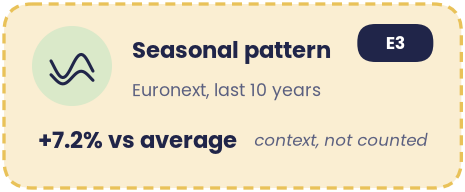
| E3 Seasonal pattern ↑ | Context, not counted: in the last 10 years the price stood 7.2% above its average for this date (78th percentile); in those years the following 28, 61 and 91 days moved -1.4%, -2.1% and -3.1% on average. This describes other years, not this season. | Euronext, 13 November 2026 | Context, not counted |
| E4 Fund positioning ↑ | Investment funds in Euronext milling wheat held 1.07% of open interest net long on 11 November 2026 (79th percentile of three years), 4.66 points lower in a week and 18.7 points lower than on 21 October 2026 (19.77%). Funds in Chicago soft red winter wheat were 13.4% net short on 3 November 2026. Funds cutting length is bearish. | Euronext and CFTC, 11 November 2026 and 3 November 2026 | A Lower |
| E5 World stocks ↑ | USDA raised 2026/27 world wheat ending stocks by 4.8 Mt to 280.8 Mt; world production of 827.5 Mt is at the 98.5th percentile since 1960. Stocks-to-use is 33.9% against 34.4% in 2025/26 (0.6 points lower, which alone would read as bullish), but the freshest revision, higher stocks, is bearish and decides the reading. Russian and Ukrainian exports were each cut 1.0 Mt to 39.0 and 11.5 Mt. | USDA, WASDE of 10 November 2026 | A Lower |
| E6 EU harvest 2026 ↑ | COCERAL puts the 2026 soft wheat crop of the EU-27 and the United Kingdom at 137.5 Mt, 7.6% below the previous season and 2.4% below its July 2026 edition (France 31.9 Mt, Germany 20.7 Mt, Romania 13.4 Mt). The 2026 crop is harvested and stored, so it speaks through the stocks that the December 2026 to May 2027 contracts ration. Smaller stocks are bullish. | COCERAL, 22 September 2026 | C Higher |
| E7 Sowing progress ↑ | Our reading: French soft wheat sowing reached 84% on 2 November 2026, 11 points ahead of the 5-year average, and emergence 48%, 1 point behind it. US winter wheat is 89% planted (5-year average 90%) and rated 49% good or excellent, 4.6 points above its 5-year average. The 2027 crop starts on a normal pace; no condition rating exists yet for French wheat. JRC MARS reports low soil moisture hampering establishment in France and southern Germany, which the weather row counts. | FranceAgriMer, 2 November 2026; USDA NASS, week to 8 November 2026; JRC MARS, 26 October 2026 | B Same level |
| E8 Weather in the growing regions ↑ | Our reading: from 1 October 2026 to 13 November 2026 Russian winter wheat areas received 38.1 mm of rain, the 3rd percentile of 30 years (second driest), with temperatures at the 97th percentile. France received 94.6 mm (20th percentile), Poland 51.5 mm (23rd) and Germany 80.8 mm (33rd), while Romania (70th) and Ukraine (67th) were wetter than usual. Germany, Poland and Romania are measured from their own season start between 26 September 2026 and 3 October 2026. Winter wheat is dormant or emerging, so this is a risk to establishment, not a yield loss; derived from the 30-year range. No yield-sensitive window is open: the French heat and Fusarium windows start on 15 May 2027. Australia ran at the 100th percentile for temperature, yet USDA raised its crop 1.5 Mt to 32.5 Mt. Dry soil in a dry spring would cut yield; rain by 12 February 2027 would remove the risk. | ECMWF AgERA5 reanalysis, 13 November 2026; JRC MARS, 26 October 2026 | C Higher |
| E9 Exports and trade flows ↑ | Our reading: EU soft wheat exports reached 10.05 Mt from 1 July 2026 to 8 November 2026, 1.6% above the same weeks of 2025/26, 14.2% above 2024/25 and 16.0% below 2023/24; the latest week (2 to 8 November 2026) was 359,308 t. The European Commission notes that French export data have been incomplete since 2024, so the total is understated. An export pace equal to 2025/26 neither tightens nor loosens the market. | European Commission, customs surveillance, 8 November 2026 | B Same level |
| E10 Importer tenders ↑ | Our reading: Algeria's state buyer is reported to have bought more than 700,000 t of milling wheat in a tender that closed on 11 November 2026, at about USD 313 per tonne including cost and freight, which is USD 46.19 above Rouen FOB (USD 266.81 on 11 November 2026); freight is part of the difference and cannot be separated. Egypt's state buyer bought about five cargoes privately in the week to 22 October 2026 as Black Sea disruptions tighten supplies. Two French vessels of more than 60,000 t each are loading for Saudi Arabia, the first French bulk wheat there since 2020. Large volumes bought at a premium point to importers expecting a tighter market. Prices and volumes are trader estimates, not official results. | Commodity3, traders cited by Reuters, 12 November 2026, 22 October 2026 and 4 November 2026 | C Higher |
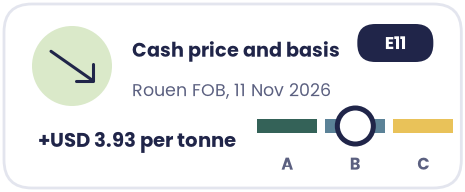
| E11 Cash price and basis ↑ | Our reading: Rouen FOB wheat (grade 1) is USD 3.93 per tonne above the Euronext front month on 11 November 2026, the 35th percentile of 7.8 years (normal) and USD 3.38 lower than a week earlier. French delivered-port bread wheat was EUR 1.07 above the front month on 2 November 2026 (48th percentile). A normal basis shows neither tight nor ample physical supply. German farm-gate bread wheat was EUR 177 per tonne on 11 November 2026, 5.9% lower in a week. | European Commission, 11 November 2026 and 2 November 2026; Euronext; German LEL, 11 November 2026 | B Same level |
| E12 Euro against the dollar ↑ | Our reading: EUR/USD stood at 1.1052 on 13 November 2026. The dollar gained 1.0% against the euro in a week and 1.3% in a month, is 5.1% stronger than a year ago and is at its strongest in 52 weeks. Dollar-priced wheat from the Black Sea and the United States costs more in euros, which is bullish for Euronext. | ECB, 13 November 2026 | C Higher |
| E13 US against EU price ↑ | Our reading: Chicago soft red winter wheat is USD 40.08 per tonne below Euronext milling wheat (13 November 2026), the 15th percentile of 10.2 years. Chicago fell 11.5% in a month to 593.25 cents per bushel, where the December 2026 contract hit a 9-month low on 12 November 2026, and Euronext 5.2%. Different qualities and delivery points make this a market spread, not a like-for-like price. A cheap world price pulls the EU benchmark down. | Chicago Board of Trade and Euronext, 13 November 2026 | A Lower |
| E14 Analogue seasons ↑ | Open: analogue seasons, the past years that ran like this one on rain and temperature, can only be matched from March 2027; the 2027 winter wheat season is days old. It does not decide now and will be read in March 2027. | Terensis, to be read in March 2027 | Open: not before March 2027 |
Readings to 13 November 2026; publishers as named in each row. Our reading marks a direction taken by judgement.
| Cost component of an example miller | Share of the selling price | Assumption in the scenarios |
|---|---|---|
| Milling wheat | 70% | Valued at Euronext milling wheat, December 2026 contract; base EUR 239.83 per tonne |
| Energy, freight, labour, packaging and margin | 30% | Unchanged against today |
Terensis cost model template for wheat flour, 14 November 2026. Shares are illustrative starting points, not industry data.

See the margin impact on your products
Same scenarios, your own cost model.
What are you preparing for?
Notes: prices are Euronext milling wheat settlements unless stated. The wheat cost of an example miller is valued on the December 2026 contract (2026 harvest, stored supply) in both periods, and one standard step (22.3% a year times the square root of 3/12 = 11.15%) is taken from the same stored-supply contracts over the 20 days to 13 November 2026. Only the wheat price moves; energy, freight, labour, packaging and margin stay at today's level. The cost structure is illustrative. USD figures are exchange and trade quotes and are not converted unless stated; tender prices are trader estimates. Our reading marks judgement. Argentina's wheat is in good condition (MAGyP, 12 November 2026) and is part of the world balance. Sources: Euronext (milling wheat settlements and fund positioning, 13 November 2026); CFTC (Commitments of Traders, 3 November 2026); USDA (WASDE No. 677, 10 November 2026); USDA NASS (Crop Progress, week 45, 8 November 2026); COCERAL (EU crop forecast, 22 September 2026); JRC MARS (October 2026 bulletin, 26 October 2026); FranceAgriMer (CerObs sowing and emergence, 2 November 2026); European Commission (cash prices, FOB prices and weekly trade, 11 November 2026); ECMWF (AgERA5 reanalysis of rain and temperature, 13 November 2026); ECB (euro reference rate, 13 November 2026); Commodity3 (Algerian tender, traders cited by Reuters, 12 November 2026); Barchart (Walsh Trading daily bullet points, 13 November 2026); MAGyP (Argentina weekly crop report, 12 November 2026). Photo: Polina Rytova, Unsplash; B S, Unsplash.
DISCLAIMER
The information contained in this report is based on data obtained from proprietary, commercial, government and statistical organizations, which Terensis believes to be reliable. While Terensis strives for accuracy, all forecasts, analyses, and assessments or other information in this report are provided "as is" without any warranty of completeness, correctness, applicability or fitness for any specific purpose. In particular, the recipient of this report acknowledges that agricultural, weather, environmental, social and other relevant conditions are inherently uncertain and subject to variables beyond the control of Terensis. Therefore, the recipient assumes full responsibility for any decisions made based on this report. To the fullest extent permitted by law, Terensis excludes all liability for any damages arising in connection with this report. No investment advice.