

Will maize cost more, less or the same in six months?
An example native starch maker buys maize ahead for six months. Euronext maize settled at EUR 259.50 per tonne on 13 November 2026; where it stands on 12 May 2027 sets the margin.
Short answer
Most likely: scenario A, the price falls from EUR 259.50 per tonne. 6 of 13 signals point there, 5 point to scenario C (higher price) and 2 to scenario B (same price). This is a share of signals, not a statistical chance, and the lead over scenario C is a single signal.
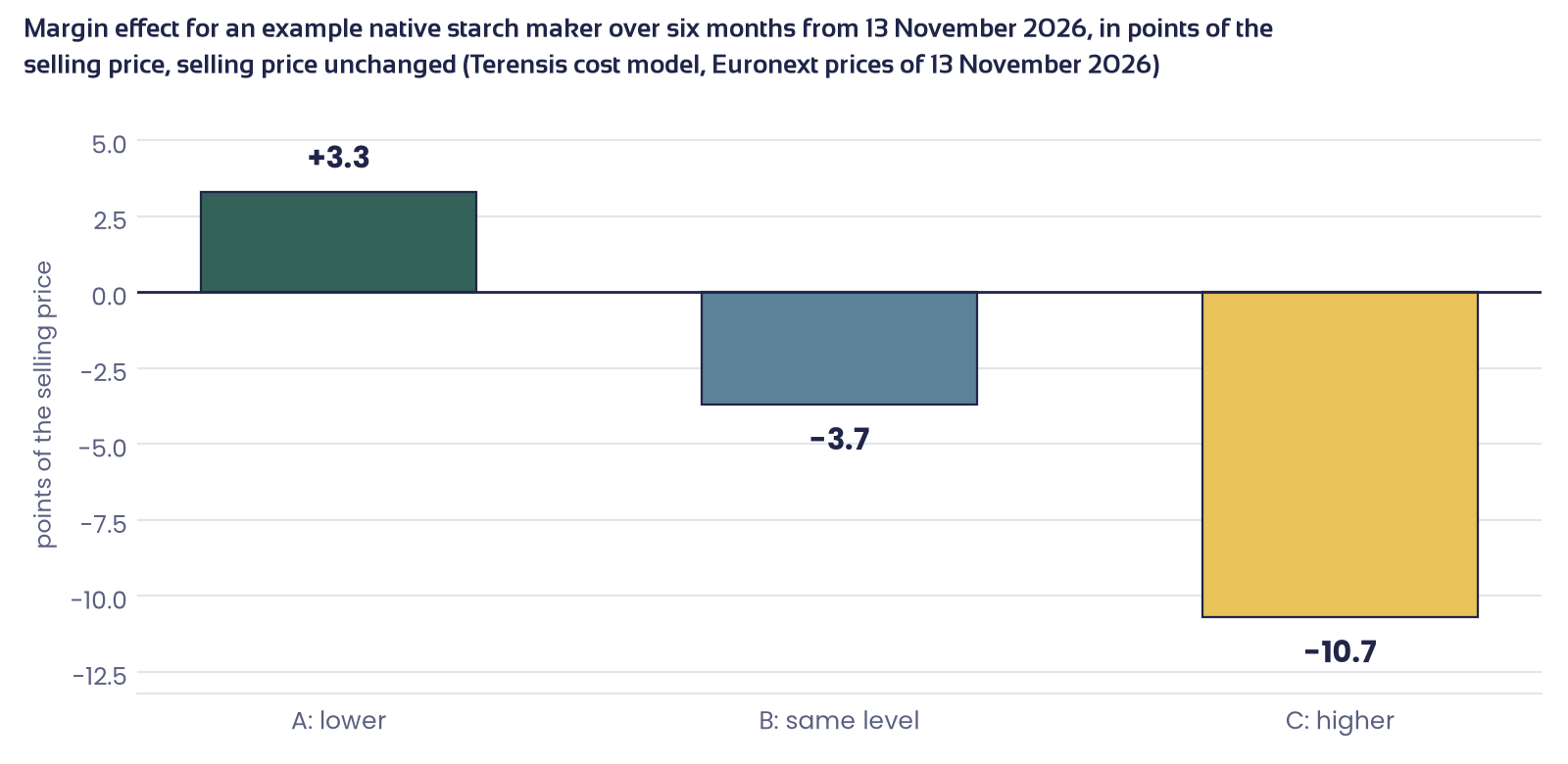
For an example native starch maker with a six-month cover, today's price is 6.4% above the maize cost already in the selling price, so even an unchanged market takes 3.7 points off the margin if the selling price stays. A move of one standard step, about EUR 29.35 per tonne, would give +3.3 points (lower) or -10.7 points (higher).
The next releases that can break the tie are the USDA world balance on 10 December 2026 and the CONAB survey of the Brazilian crop on 15 December 2026.
Three scenarios for the Euronext maize price on 12 May 2027
Share of signals, not a statistical chance. Prices: Euronext settlement of the March 2027 contract on 13 November 2026 (EUR 259.50), plus or minus one standard step of 11.31%. Margin effect in points of the selling price for an example native starch maker, selling price unchanged. Illustrative cost structure.
Read the full Margin Call
Leave your email address to read the scenarios in detail, the evidence behind every signal and the cost model, and to download the PDF.
We use your email address to give you access and to follow up on this Margin Call. You can object at any time. More in our privacy policy.
1. Which scenario is most realistic?
Of the 13 signals with a current reading, 6 point to scenario A (lower price), 5 to scenario C (higher price) and 2 to scenario B (same price), on readings to 13 November 2026. Signals marked as our reading are judgement; the others follow the direction the data states. Two signals are mixed or too early to read and are not counted, and two tiles are context: a seasonal pattern of other years and the El Niño outlook.



Euronext, CFTC, USDA, CONAB, JRC MARS, MAGyP, European Commission, ECB and Commodity3, readings to 13 November 2026.
Why scenario A leads. The price of EUR 259.50 sits below its 20-day, 50-day and 100-day averages (EUR 276.11, EUR 274.00 and EUR 262.78) and 17.1% under its high of EUR 313.00 on 30 October 2026. Funds cut their net length on both exchanges, EU maize imports run 30.2% above the same weeks of 2025/26, American maize is EUR 61.09 per tonne cheaper than Euronext before freight, and USDA and CONAB expect larger South American crops. Against that, the nearby months stand above the new crop, world stocks-to-use fell to 21.4%, the US yield was cut, the EU yield is 9% below its average and the euro is weak (5 signals).
What the headline hides. Euronext maize is 36.2% above a year ago, yet it has lost EUR 53.50 per tonne since 30 October 2026. It trades USD 111.41 per tonne above Chicago maize, the widest premium in 10.2 years but one that includes a quality premium for EU non-GMO maize and a short EU crop. Euronext funds still hold 9.69% of open interest net long (78th percentile of three years), so more selling is possible.
What would break the tie. Scenario A leads scenario C by one signal. World ending stocks above 281.94 Mt in the USDA report of 10 December 2026 would add weight to scenario A (stocks were revised materially in 2 of the last 10 Novembers, both times upward); a further cut of the US yield below 179.6 bushels per acre or of the EU yield below 6.42 tonnes per hectare would move the lead to scenario C.
2. How do the other scenarios answer it?
- Scenario C: higher price (5 of 13 signals). USDA cut the US yield by 1.6 bushels to 179.6 bushels per acre on 10 November 2026 and world ending stocks to 281.94 Mt (stocks-to-use 21.4% against 23.3%), JRC MARS puts the EU grain maize yield at 6.42 tonnes per hectare, 9% below its 5-year average, the euro stands at USD 1.1052, and Turkey bought about 295,000 t of feed maize on 12 November 2026. Scenario C needs the cold, wet start of the southern crops to cut into the area or yield before the sensitive window from 3 March 2027, and imports to stay dearer than the EU price. It is confirmed if the nearest contract settles at or above about EUR 289 per tonne on 12 May 2027.
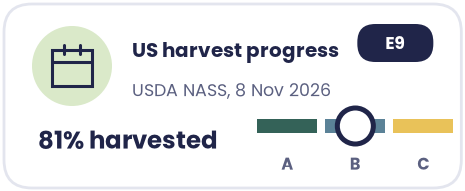
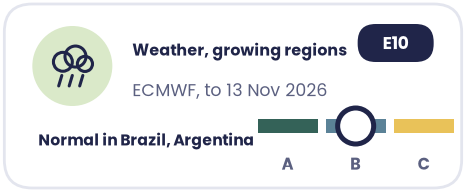
- Scenario B: same price (2 of 13 signals). US harvest progress (81%, behind the average of 86%) and realised weather in Brazil and Argentina are normal. A price that stays near EUR 259.50 needs the short EU crop and the cheaper world supply to offset each other for six months. It is confirmed if the nearest contract settles between about EUR 230 and EUR 289 per tonne, near EUR 259.50, on 12 May 2027.
The southern crops are being planted in November 2026, so the weather signal is about the start of the crop, not a yield. The comparison with past seasons stops on 31 October 2026, before the yield-sensitive window, and the three closest Argentine seasons range from -7.2% to +19.6% of trend yield.
3. What do the scenarios mean for margin?
Base
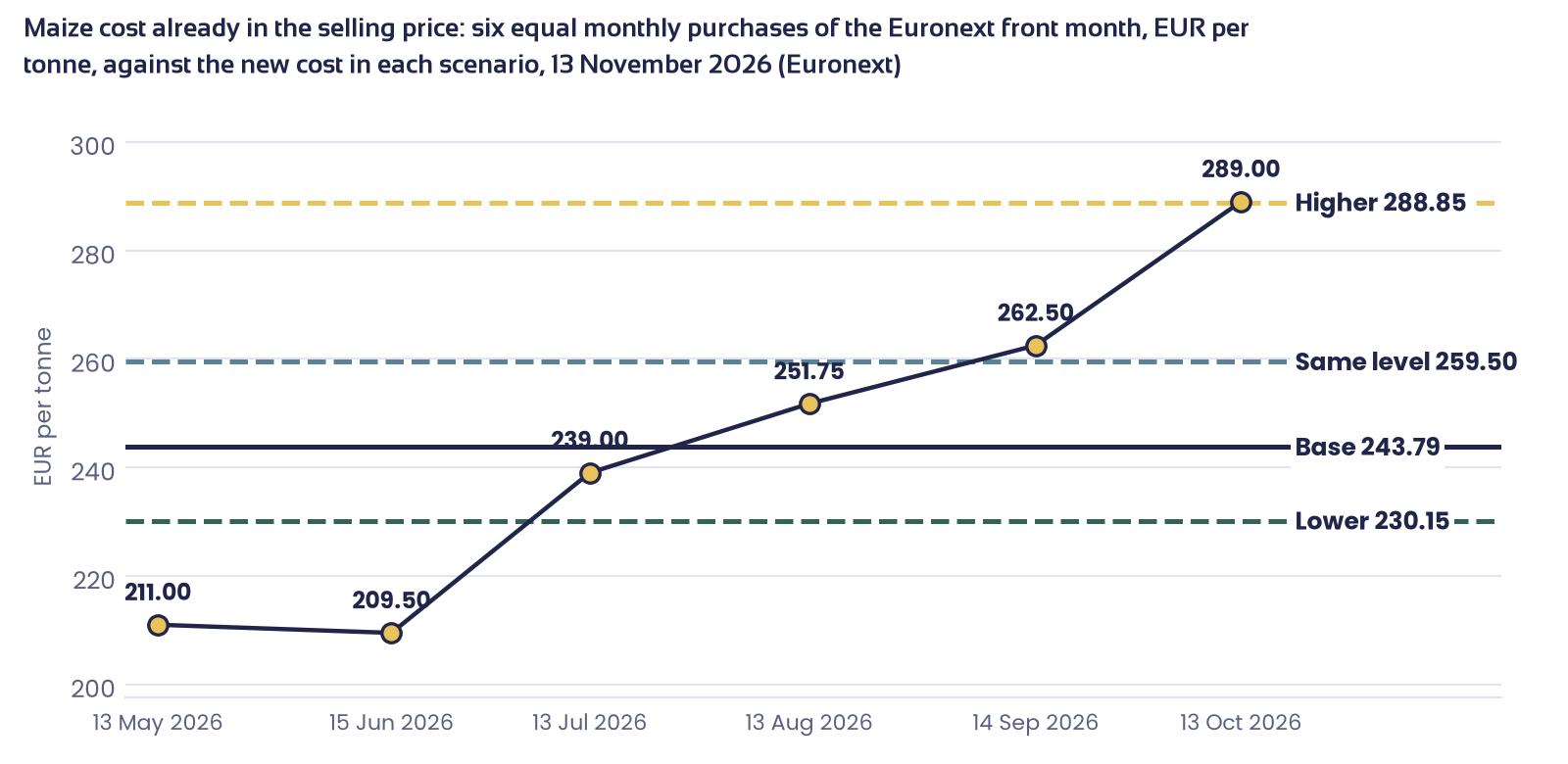
Base: the maize cost that is already in the selling price today. It is the average price of equal monthly purchases from 13 May 2026 to 13 November 2026. How to read the numbers: "-2.0" means that of every EUR 100 of sales, EUR 2 less stays as margin. "+1.0" means EUR 1 more stays. The selling price is assumed unchanged.
| Scenario | Maize price assumed, EUR per tonne | Change in maize cost against the base | Margin effect, points of the selling price |
|---|---|---|---|
| A Lower | 230.15 (one standard step below) | -5.6% | +3.3 |
| B Same level | 259.50 (settlement of 13 November 2026) | +6.4% | -3.7 |
| C Higher | 288.85 (one standard step above) | +18.5% | -10.7 |
Terensis cost model for an example native starch maker (maize 58% of the price, other costs 42%), Euronext prices of 13 November 2026. Illustrative.
The base cost is EUR 243.79 per tonne: six equal monthly purchases of the Euronext front month at EUR 211.00 (13 May 2026), EUR 209.50 (15 June 2026), EUR 239.00 (13 July 2026), EUR 251.75 (13 August 2026), EUR 262.50 (14 September 2026) and EUR 289.00 (13 October 2026). Today's price of EUR 259.50 is EUR 15.71 above it, so even an unchanged market raises the maize cost by 6.4%.
One standard step is the typical size of price swings over the cover period: 16.0% a year for the March 2027 contract over the 20 days to 13 November 2026, times the square root of 6/12, gives 11.31%, or EUR 29.35 per tonne on EUR 259.50. This is a fixed rule, not a forecast. The March 2027 contract carries the six-month cover and values both periods; the November 2026 contract is about to expire and is not used. Only the maize price moves; energy, freight, labour, packaging and margin stay at today's level. The market curve gives +3.77 points of cost against +3.74 for scenario B, a difference below 0.5 points, so it is not shown.
4. What should I do now?
Scenario A is the most realistic, but it leads by one signal and a move of one standard step in six months is normal for this market. These are options to weigh, not advice.
Price levels that change the call
Open questions the market has not answered yet
- Will USDA raise or cut world stocks again? The USDA report of 10 December 2026 (projected date) against 281.94 Mt of world ending stocks, and against a US yield of 179.6 bushels per acre.
- Will the EU yield fall further? The JRC MARS bulletin expected by 4 December 2026 against 6.42 tonnes per hectare.
- How large is the South American crop? The CONAB survey of 15 December 2026 against 148.0 Mt in total, and the weather until the sensitive window from 3 March 2027.
- Is Turkey's purchase a trend? The next Turkish and Korean feed maize tenders: their prices against the French and Argentine FOB levels, which the reports do not state yet.
| Date | Release | Signals it can change | What would change the call |
|---|---|---|---|
| 16 November 2026 | USDA Crop Progress (confirmed) | E9 US harvest progress | A harvest still well behind the 5-year average of 86% keeps E9 at scenario B; a catch-up to the average removes the delay and changes nothing in the count. |
| 25 November 2026 | US PCE inflation (confirmed) | E16 Euro against the dollar | A print above 0.278% a month (CBOT maize -0.07% on average, 51 releases) or below 0.16% (+0.04%, 41 releases) has shown no reliable effect; only a lasting move of the euro changes E16. |
| 4 December 2026 | JRC MARS bulletin (expected by this date) | E6 US and EU harvest | An EU grain maize yield below 6.42 tonnes per hectare adds weight to scenario C; a revision upward weakens E6. |
| 10 December 2026 | USDA WASDE (projected date) | E5 World stocks, E6 US and EU harvest, E7 South American crops, E8 Demand | World ending stocks above 281.94 Mt add weight to scenario A (stocks were revised materially in 2 of 10 past Novembers, both upward); a cut below 281.94 Mt or a US yield below 179.6 bushels per acre adds weight to scenario C. |
| 15 December 2026 | CONAB grain survey (confirmed) | E7 South American crops | A Brazilian total above 148.0 Mt adds weight to scenario A; a total below it weakens E7 and favours scenario C. |
Upcoming releases that can change the call: Terensis release calendar read on 14 November 2026 (USDA, BEA and CONAB schedules; the JRC MARS date is an upper bound).
5. Evidence
| Evidence | Reading | Source and date | Points to |
|---|---|---|---|
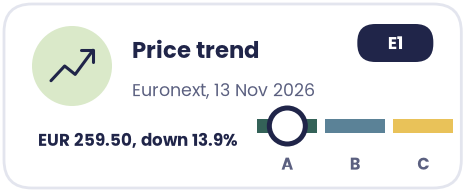
| E1 Price trend ↑ | Our reading: Euronext maize (nearest contract, March 2027) settled at EUR 259.50 per tonne on 13 November 2026, below its 20-day average (EUR 276.11), 50-day average (EUR 274.00) and 100-day average (EUR 262.78) and above its 200-day average (EUR 236.20). It rose 5.0% in the week after a low of EUR 244.00 on 6 November 2026, fell 13.9% in the month and is 36.2% above a year ago; 52-week range EUR 185.25 (15 December 2025) to EUR 313.00 (30 October 2026). A price under its short averages and 17.1% under its high points to a lower price. | Euronext, settled 13 November 2026 | A Lower |
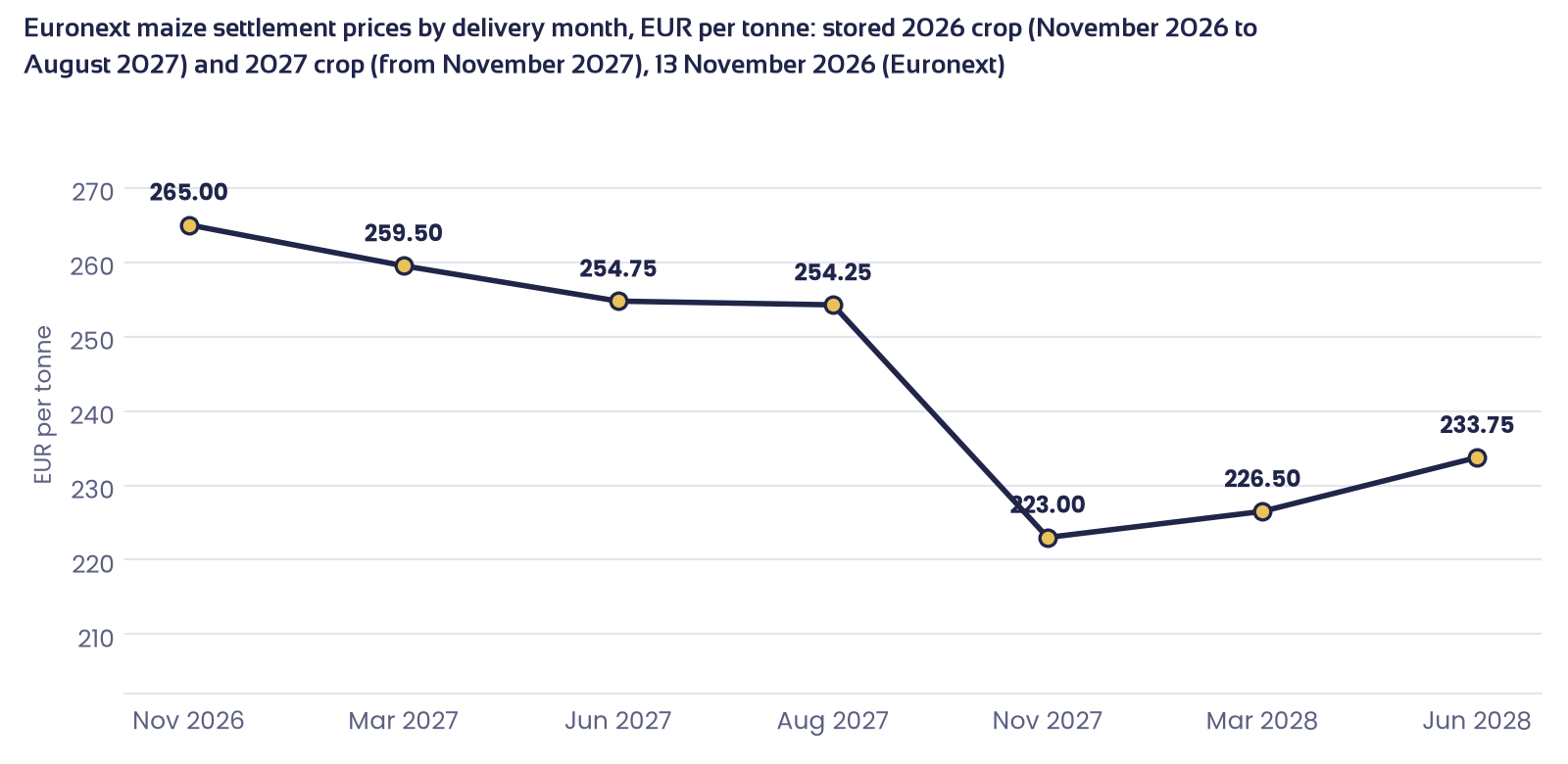
| E2 Shape of the futures curve ↑ | Prices for nearby months are higher than for later months: November 2026 EUR 265.00, March 2027 EUR 259.50, June 2027 EUR 254.75, August 2027 EUR 254.25, then the 2027 crop at EUR 223.00 (November 2027), EUR 31.25 below the August 2027 contract of stored maize. The stored 2026 crop is priced above the new crop, which reads as tight nearby supply and is bullish. | Euronext, settled 13 November 2026 | C Higher |
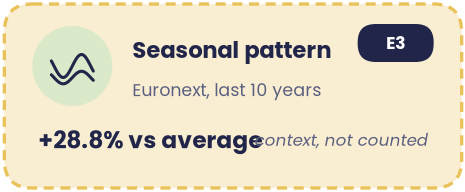
| E3 Seasonal pattern ↑ | Context, not counted: in the last 10 years the price stood 28.8% above its average for this date (90th percentile); in those years the following 28, 61 and 91 days moved -1.8%, -2.1% and -1.8% on average. This describes other years, not this season. | Euronext, 13 November 2026 | Context, not counted |
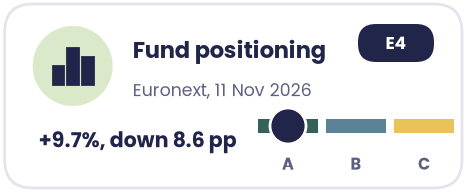
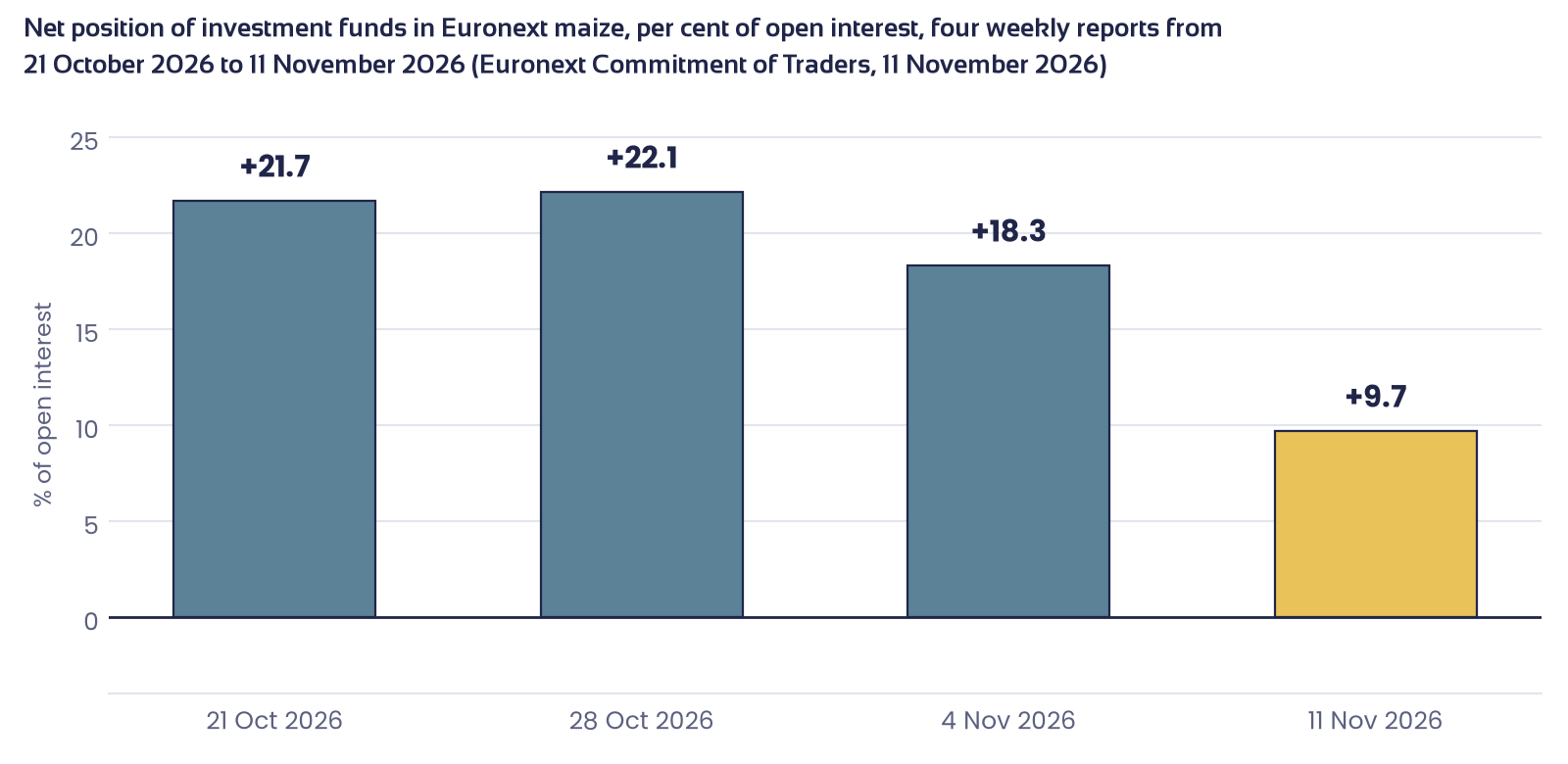
| E4 Fund positioning ↑ | Investment funds in Euronext maize held 9.69% of open interest net long on 11 November 2026 (78th percentile of three years), 8.62 points lower in a week and 12.0 points lower than on 21 October 2026 (21.68%). Funds in Chicago maize were 0.9% net short on 3 November 2026, 10.1 points lower than on 13 October 2026 (9.2% net long). Funds cutting length is bearish on both exchanges. | Euronext, 11 November 2026, and CFTC, 3 November 2026 | A Lower |
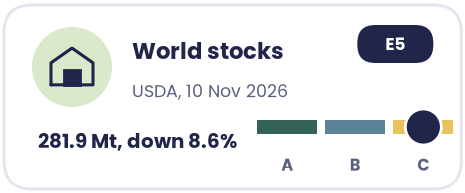
| E5 World stocks ↑ | USDA projects 2026/27 world maize ending stocks at 281.94 Mt, 8.6% below the 308.31 Mt of 2025/26; stocks-to-use is 21.4% against 23.3%, a fall that is bullish. World production of 1,291.55 Mt is 3.2% lower. Against the October 2026 edition, stocks were raised 1.5 Mt (a change the data reads as flat). | USDA, WASDE of 10 November 2026 | C Higher |
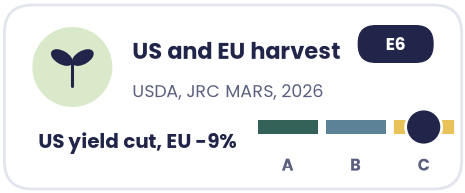
| E6 US and EU harvest ↑ | The 2026 crops are harvested and in store, so they speak through the stocks that the March 2027 to August 2027 contracts ration. USDA cut the US yield by 1.6 bushels to 179.6 bushels per acre and US production by 141 million bushels to 15.9 billion. JRC MARS puts the EU grain maize yield at 6.42 tonnes per hectare, 9% below the 5-year average of 7.09 (France 6.30, 31% below; Hungary 3.12, 46% below). COCERAL puts the EU-27 maize crop at 48.6 Mt, 14% below the previous harvest and 7.8% below its July 2026 edition (France 7.6 Mt, Poland 9.2 Mt, Romania 7.7 Mt). Smaller crops are bullish. | USDA, 10 November 2026; JRC MARS, 26 October 2026; COCERAL, 22 September 2026 | C Higher |
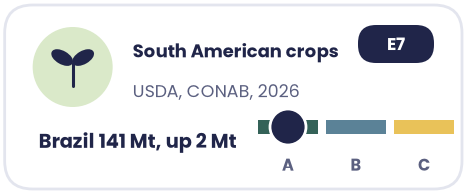
| E7 South American crops ↑ | USDA raised its 2026/27 forecast for Brazil by 2.0 Mt to 141.0 Mt (larger first-crop area) and for Argentina by 2.0 Mt to 57.0 Mt (planting ahead of normal). CONAB puts Brazil's 2026/27 total at 148.0 Mt, 2.4% above last season, with first-crop area up 8.7% to 4.10 million hectares; its survey is unchanged from the previous one. These crops arrive from January 2027 and compete for export demand; larger supply is bearish. | USDA, 10 November 2026; CONAB, 1 November 2026 | A Lower |
| E8 Demand ↑ | Mixed: USDA's 2026/27 world maize use of 1,309.96 Mt is 0.3% above last season (flat), while world exports of 209.38 Mt are 2.8% below (lower demand, bearish) and were cut 1.34 Mt in the month (Ukraine -2 Mt to 20 Mt, Argentina +2 Mt to 40 Mt). The components disagree, so the row does not decide. | USDA, WASDE of 10 November 2026 | Open: mixed reading |
| E9 US harvest progress ↑ | Our reading: the US maize harvest was 81% complete on 8 November 2026, against 74% a week earlier and 86% for the 5-year average (Iowa 72%, 17 points behind; South Dakota 68%). The yield is already measured in the USDA report of 10 November 2026, so a slow harvest delays arrivals but does not change the crop. No condition rating is published for the harvest period. | USDA NASS, week to 8 November 2026 | B Same level |
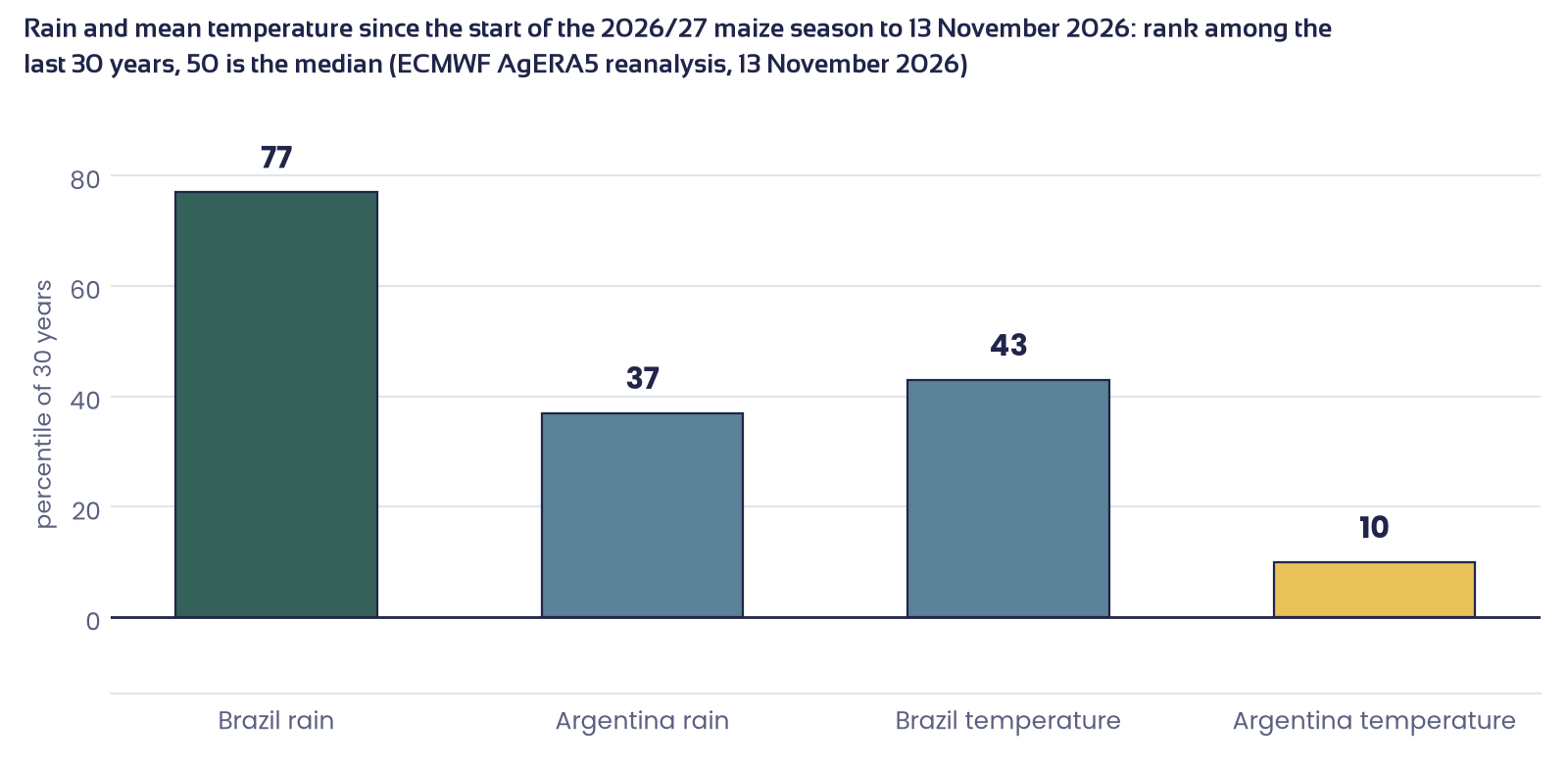
| E10 Weather in the growing regions ↑ | Our reading: Brazil received 329.8 mm of rain from 1 September 2026 to 13 November 2026 against a median of 277.6 mm (77th percentile of 30 years) at a normal mean temperature of 23.0 degrees (43rd percentile); CONAB reports first-crop maize 51.2% sown on 9 November 2026, with excess moisture and replanting in Paraná, Santa Catarina and Rio Grande do Sul. Argentina received 152.5 mm from 9 September 2026 against a median of 172.4 mm (37th percentile) but was cool: mean temperature 16.8 degrees (10th percentile) and maximum 21.9 degrees (7th percentile); MAGyP reports ideal soil moisture and early maize sown, with growth slowed by cold, cloudy weeks and hail in Córdoba and Santa Fe on 12 November 2026. The Brazilian yield-sensitive window runs from 3 March 2027 to 2 April 2027 and is not open. Derived from the 30-year range, the start of the crops is normal; a dry January 2027 in Argentina or southern Brazil would change this. | ECMWF AgERA5 reanalysis, 13 November 2026; CONAB, 9 November 2026; MAGyP, 12 November 2026 | B Same level |
| E11 Analogue seasons ↑ | Open: the past seasons that ran like this one on rain and temperature are matched only to 31 October 2026, before the yield-sensitive window. For Argentina the three closest seasons (2011, 2016, 2005) ran at -7.2%, +5.2% and +19.6% of trend yield (mean +5.9%); for Brazil's first crop, 18% of the Brazilian maize, they ran at -0.7%, -1.3% and +0.8% (mean -0.4%). The spread is too wide to decide before January 2027. | Terensis, to be read again in January 2027 | Open: too early |
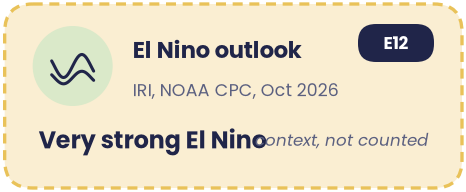
| E12 El Niño outlook ↑ | Context, not counted: IRI reports a very strong El Niño (weekly Niño 3.4 index +3.3 degrees on 14 October 2026) with a 100% probability through March 2027 and NOAA expects it to peak in winter. For Argentina, maize yields in El Niño years were a median 8.4% above trend (22 years; +4.3% per degree, 90% interval +1.2% to +7.7%); for Brazil no robust link exists (+0.1% per degree, p-value 0.90). A statistical link from other years, checked against the realised weather in E10, which is normal so far. | IRI, Columbia University, 19 October 2026; NOAA Climate Prediction Center, 15 October 2026 | Context, not counted |
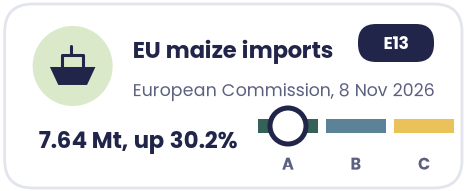
| E13 EU maize imports ↑ | Our reading: EU maize imports reached 7.64 Mt from 1 July 2026 to 8 November 2026, 30.2% above the same weeks of 2025/26 and 1.6% above 2024/25 (Spain 44.4%, Portugal 15.2%, Italy 13.2%); the last two weeks fell to 241,508 t and 151,882 t after 684,617 t in the week to 18 October 2026. EU exports were 519,759 t (+11.2%); French export data are incomplete. US Gulf maize costs USD 219.28 per tonne FOB (EUR 198.41 at 1.1052, 11 November 2026), EUR 61.09 below Euronext before freight; the US maize is not non-GMO. Imports that keep arriving at this level ease the EU market. | European Commission, customs surveillance, week to 8 November 2026; European Commission, FOB prices, 11 November 2026 | A Lower |
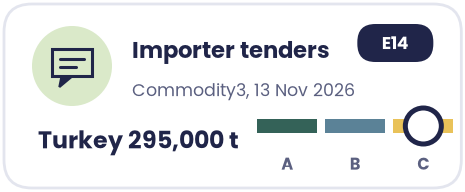
| E14 Importer tenders ↑ | Our reading: Turkey's grain board TMO provisionally bought about 295,000 t of feed maize in a tender on 12 November 2026; South Korea's KFA bought about 68,000 t privately (reported 30 October 2026) and CAPI up to 67,000 t (3 November 2026), and NOFI tendered for up to 138,000 t (29 October 2026). USDA reported private sales to Mexico of 312,700 t (10 November 2026) and 303,800 t (13 November 2026). The prices are not stated, so the premium over FOB and futures cannot be judged; the volumes show importers buying after the price fall. Volumes are trader reports, not official results. | Commodity3, traders cited by Reuters, 13 November 2026; Barchart, 13 November 2026 | C Higher |
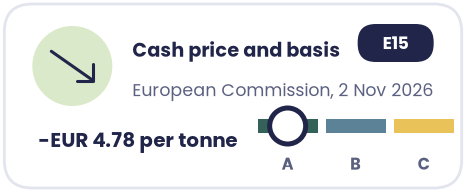
| E15 Cash price and basis ↑ | Our reading: French delivered-port maize was EUR 4.78 per tonne below the Euronext front month on 2 November 2026 (7th percentile of 2.3 years) and Rhin FOB maize EUR 16.78 below (7th percentile), against a front month of EUR 276.50 on that day. A basis this weak shows ample physical supply. The cash quotes are weekly and the futures have fallen EUR 17.00 since, so the basis may have narrowed. German farm-gate maize was EUR 245.00 per tonne on 11 November 2026, 2.0% lower in a week. | European Commission, 2 November 2026; Euronext; German LEL, 11 November 2026 | A Lower |
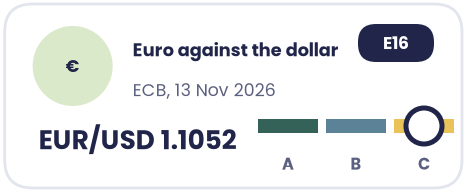
| E16 Euro against the dollar ↑ | Our reading: EUR/USD stood at 1.1052 on 13 November 2026. The dollar gained 1.0% against the euro in a week and 1.3% in a month, is 5.1% stronger than a year ago and is at its strongest in 52 weeks. Dollar-priced maize from the United States and Argentina costs more in euros, which is bullish for Euronext. | ECB, 13 November 2026 | C Higher |
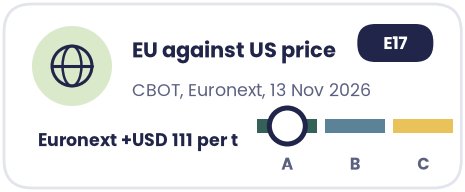
| E17 EU against US price ↑ | Our reading: Chicago maize at 445.5 US cents per bushel (USD 175.39 per tonne) is USD 111.41 below Euronext maize (EUR 259.50, USD 286.80 at 1.1052) on 13 November 2026, the 2nd percentile of 10.2 years (typical premium USD 48.46); it was USD 167.55 on 30 October 2026. EU maize is non-GMO and the EU crop is short, so part of the premium is quality and not a like-for-like price. A premium this wide pulls the EU benchmark toward the world price. | Chicago Board of Trade and Euronext, 13 November 2026 | A Lower |
Readings to 13 November 2026; publishers as named in each row. Our reading marks a direction taken by judgement.
| Cost component of an example native starch maker | Share of the selling price | Assumption in the scenarios |
|---|---|---|
| Maize | 58% | Valued at the Euronext front month (March 2027 contract); base EUR 243.79 per tonne |
| Energy, freight, labour, packaging and margin | 42% | Unchanged against today |
Terensis cost model template for native corn starch, 14 November 2026. Shares are illustrative starting points, not industry data.

See the margin impact on your products
Same scenarios, your own cost model.
What are you preparing for?
Notes: prices are Euronext maize settlements unless stated. The maize cost of an example native starch maker is valued on the front month, the March 2027 contract (stored 2026 crop), in both periods, and one standard step (16.0% a year for that contract times the square root of 6/12 = 11.31%) is taken over the 20 days to 13 November 2026. Only the maize price moves; energy, freight, labour, packaging and margin stay at today's level. The cost structure is illustrative. USD figures are exchange and trade quotes and are converted at EUR/USD 1.1052 of 13 November 2026 where stated; tender volumes are trader reports. US and Argentine maize is not non-GMO, so comparisons with EU maize include a quality difference. Our reading marks judgement. Weather in the United States, Ukraine and the EU is not read: their crops are harvested. Sources: Euronext (maize settlements and fund positioning, 13 November 2026); CFTC (Commitments of Traders, 3 November 2026); USDA (WASDE No. 677, 10 November 2026); USDA NASS (Crop Progress, week 45, 8 November 2026); CONAB (grain survey and weekly crop conditions, 9 November 2026); JRC MARS (October 2026 bulletin, 26 October 2026); COCERAL (EU crop forecast, 22 September 2026); MAGyP (Argentina weekly crop report, 12 November 2026); IRI, Columbia University (ENSO Quick Look, 19 October 2026); NOAA Climate Prediction Center (ENSO discussion, 15 October 2026); European Commission (cash prices, FOB prices and weekly trade, 11 November 2026); ECMWF (AgERA5 reanalysis of rain and temperature, 13 November 2026); ECB (euro reference rate, 13 November 2026); Commodity3 (Turkish maize tender, traders cited by Reuters, 13 November 2026); Barchart (USDA private export sales, 13 November 2026). Photo: Waldemar Brandt, Unsplash; Jesse Gardner, Unsplash.
DISCLAIMER
The information contained in this report is based on data obtained from proprietary, commercial, government and statistical organizations, which Terensis believes to be reliable. While Terensis strives for accuracy, all forecasts, analyses, and assessments or other information in this report are provided "as is" without any warranty of completeness, correctness, applicability or fitness for any specific purpose. In particular, the recipient of this report acknowledges that agricultural, weather, environmental, social and other relevant conditions are inherently uncertain and subject to variables beyond the control of Terensis. Therefore, the recipient assumes full responsibility for any decisions made based on this report. To the fullest extent permitted by law, Terensis excludes all liability for any damages arising in connection with this report. No investment advice.