
Will the arabica coffee price an example roaster pays be lower, the same or higher over the next six months?
ICE arabica settled at 278.65 US cents per pound (EUR 2.52 per lb) on 13 November 2026. Cover period of an example roaster: 13 November 2026 to 13 May 2027.
The short answer
Our reading: scenario A, a lower price, is the most realistic. 6 of 10 signals point to it, 4 point to scenario C (higher price) and none to scenario B (same price). The count is the share of signals that point to each scenario, not a statistical chance.
The price is below all its averages, Brazil shipped a record 5.02 million bags in October 2026, the Brazilian real is at its weakest in 52 weeks and world stocks are rising. Coffee held in exchange-approved warehouses is at the 4th percentile of its records, so nearby supply stays tight (ICE Futures US, 12 November 2026; Cecafe, 12 November 2026).
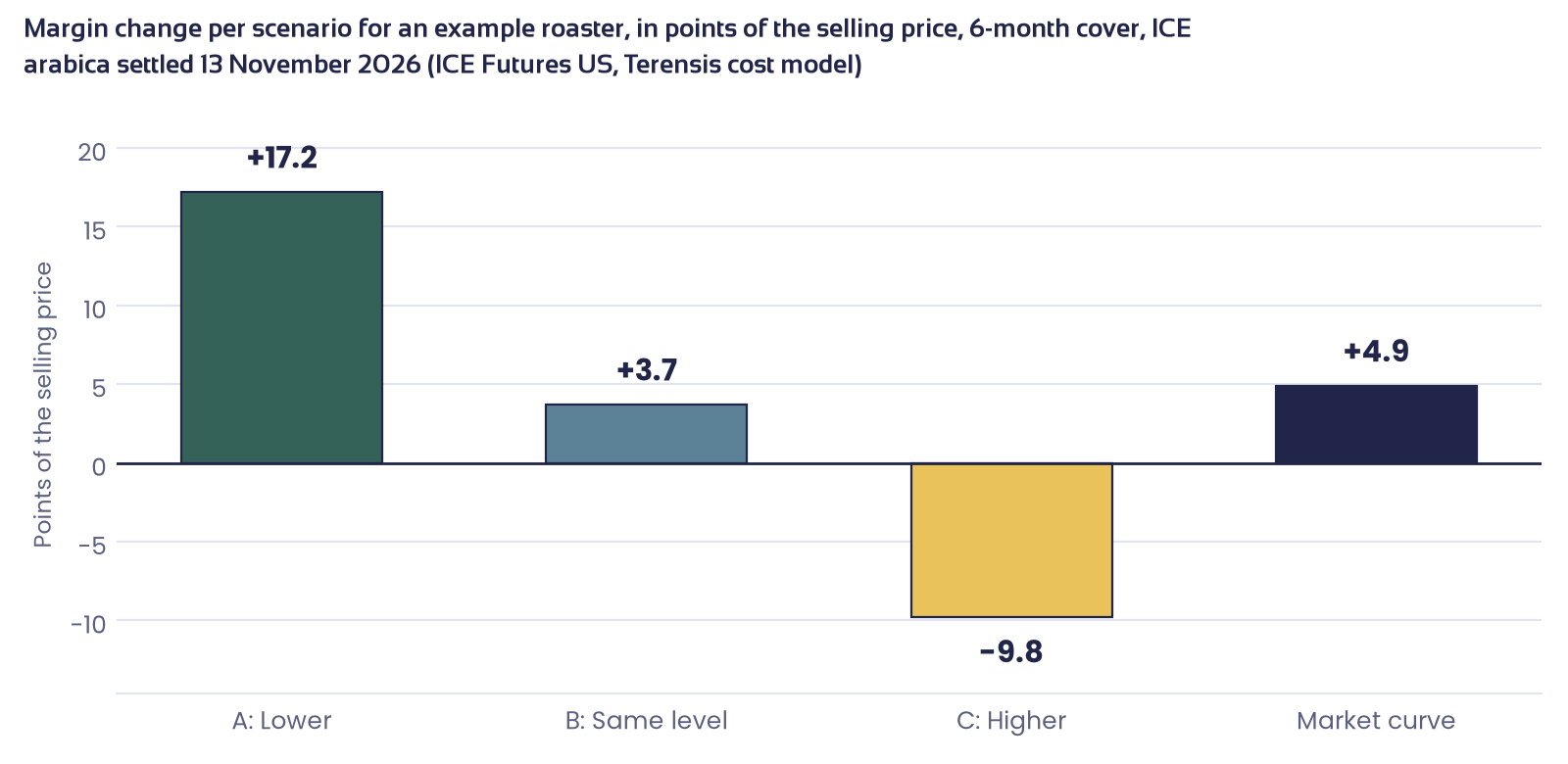
For an example roaster with six months of cover and an unchanged selling price, the margin changes by +17.2 points in scenario A, +3.7 in scenario B and -9.8 in scenario C (Terensis cost model, 13 November 2026).
Three scenarios for the arabica price over the next six months
Prices are ICE Futures US settles of 13 November 2026 converted at the exchange rate of that day. Margin change in points of the selling price for an example roaster with 6 months of cover and an unchanged selling price (Terensis cost model, 13 November 2026).
Read the full Margin Call
Leave your email address to read the scenarios in detail, the evidence behind every signal and the cost model, and to download the PDF.
We use your email address to give you access and to follow up on this Margin Call. You can object at any time. More in our privacy policy.
1. Which scenario is most realistic?
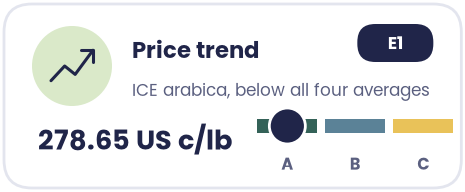
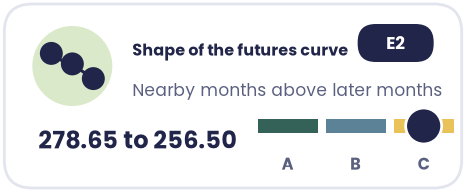
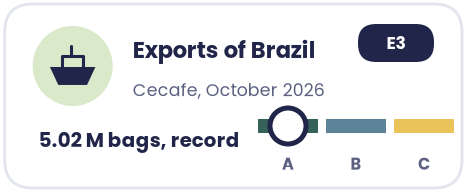
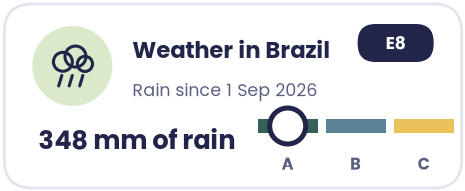
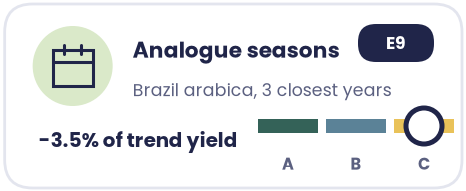
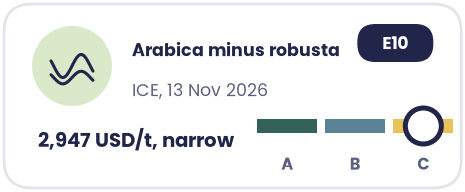
Scenario A is the most realistic, with 6 of 10 signals. Six signals point to a lower price: the price trend, Brazil's record exports, world stocks, fund positioning, the Brazilian real and the weather in Brazil's growing regions. Four point to a higher price: the shape of the futures curve, exchange stocks, analogue seasons and the difference between arabica and robusta. Each card links to its evidence row in part 5. A filled dot is a measured reading, a hollow dot is our reading (ICE Futures US, CFTC, USDA, Cecafe and ECMWF, data to 13 November 2026).

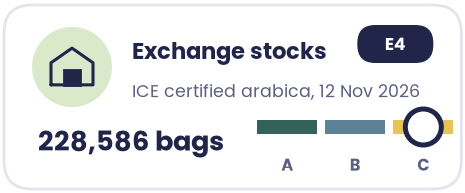
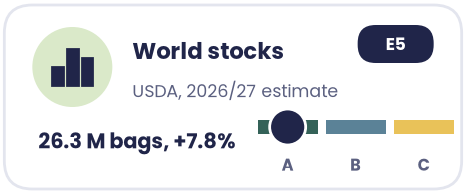
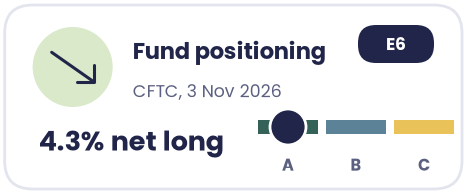
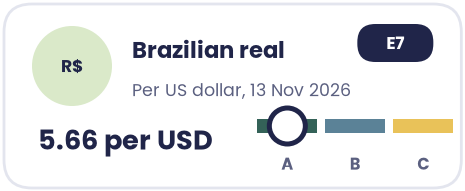

Terensis reading of ICE Futures US (13 November 2026), CFTC (3 November 2026), USDA (1 July 2026), CONAB (1 September 2026), Cecafe (12 November 2026) and ECMWF (13 November 2026).
Where the signals disagree. Two kinds of evidence have different horizons. Coffee held in exchange-approved warehouses is at the 4th percentile of its records (228,586 bags on 12 November 2026, 43.5% below a year earlier), so nearby supply is tight. The world balance and the shipment flow have the longer horizon and point down: USDA sees world stocks 7.8% higher in 2026/27, and Brazil shipped a record 5.02 million bags in October 2026. We do not average the two. For a six-month cover the longer horizon counts more (ICE Futures US, 12 November 2026; USDA Foreign Agricultural Service, 1 July 2026; Cecafe, 12 November 2026).
What the headline hides. Arabica is 30.6% below a year ago, but still 14.8% above its 52-week low of 242.70 US cents per pound (9 June 2026). The CONAB figure of 67.6 million bags (+19.6%, 1 September 2026) is the 2026 crop, which is already harvested; the 2027 crop is flowering now and has no agency estimate yet. Investment funds hold only 4.3% of open interest net long, the 2nd percentile of three years, so a short-covering rally is possible even in scenario A (CFTC, 3 November 2026).
| Who | View | Against scenario A |
|---|---|---|
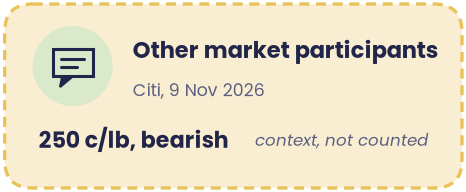
| Citi, via Commodity3, 9 November 2026 | Bearish: ICE arabica at 250 US cents per pound in three months and 225 in twelve months. Citi sees the market nearing an inflection point, with potential for a downward correction before year-end. | Agrees with scenario A: both levels are below today's 278.65, and the 12-month level of 225 is close to the 223.7 of scenario A. |
Commodity3 (Citi), 9 November 2026. Context, not counted.
2. How do the other scenarios answer it?
| Scenario | Price level | What would have to happen | Signals |
|---|---|---|---|
| B: Same level | 278.65 US cents per pound (EUR 2.52 per lb) | Tight exchange stocks keep the nearby price up while Brazilian shipments return to a normal pace and the real recovers. Confirmed if the nearest ICE arabica contract settles near 278.65 through to 13 May 2027. | 0 of 10 |
| C: Higher | 333.6 US cents per pound (EUR 3.02 per lb) | A smaller 2027 Brazilian crop after the 2026 on-year, certified stocks below their 52-week low of 217,646 bags, and funds buying back their short bets. Confirmed if the nearest ICE arabica contract settles at or above 333.6. | 4 of 10 |
Terensis scenario sizing on ICE Futures US settles of 13 November 2026; CFTC, 3 November 2026; ICE Futures US stocks, 12 November 2026.
Why scenario C is not far behind. Coffee trees bear heavily in one year and lightly in the next. CONAB calls 2026 the on-year of this cycle (1 September 2026), and a weather window cannot capture the effect (IAC, Nunes and others, 2010). The three past seasons that matched this one best on rain and warmth ran on average 3.5% below trend yield (ECMWF, weather to 31 October 2026). Realised rain is the opposite signal: Brazil's arabica areas had 348 mm from 1 September 2026 to 13 November 2026, the 97th percentile of 30 years (ECMWF AgERA5, 13 November 2026). Our reading: the two offset, and the first agency estimate for the 2027 crop decides.
Why scenario B has no support. Every signal with a reading points up or down. Exchange stocks and the curve say nearby supply is tight, and the trend, shipments and the real say more supply is coming. A flat price would need both to fade at once.
3. What do the scenarios mean for margin?
Base and how to read the numbers
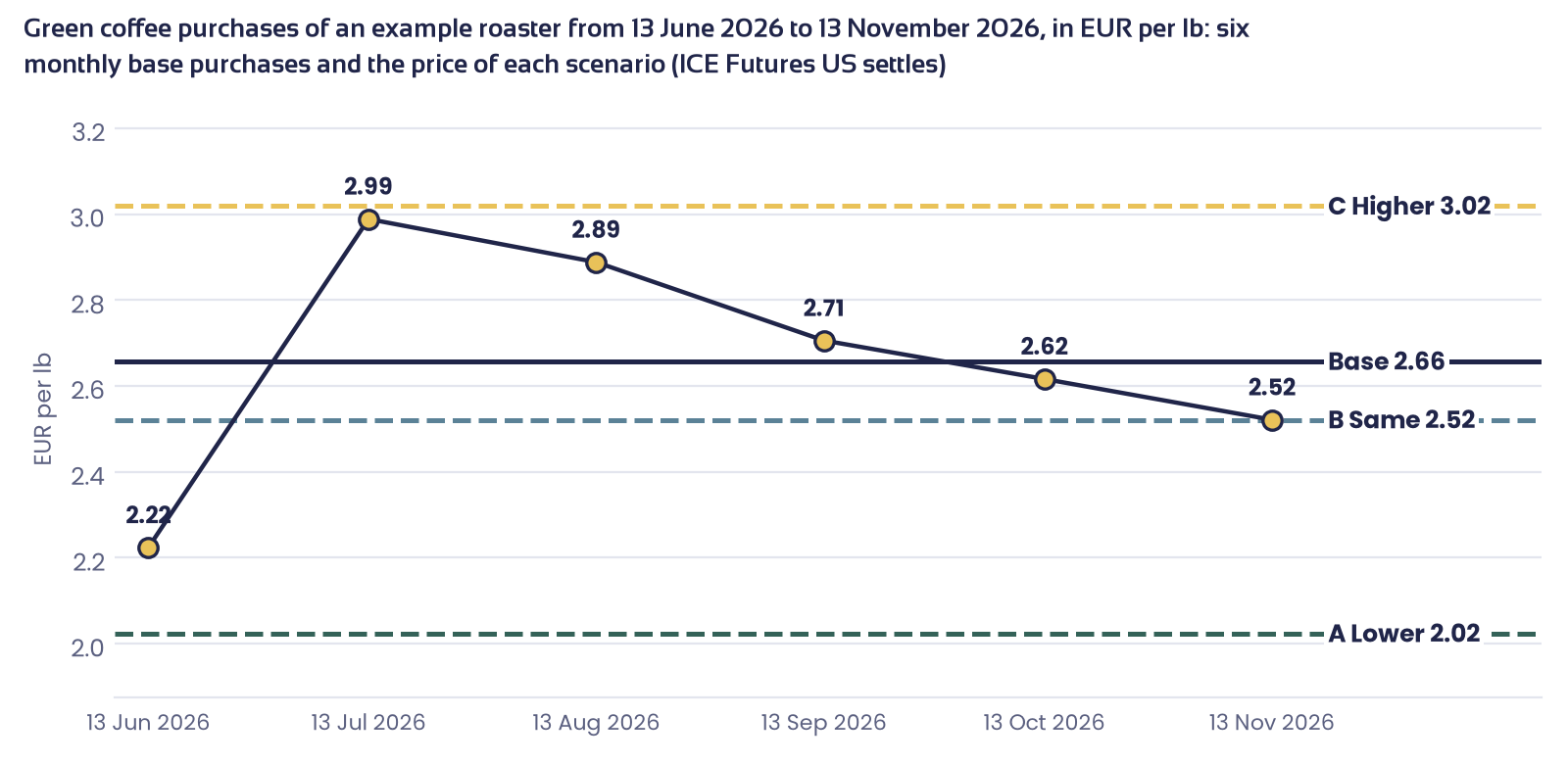
Base: the coffee cost that is already in the selling price today. It is the average price of equal monthly purchases from 13 June 2026 to 13 November 2026. How to read the numbers: "-2.0" means that of every EUR 100 of sales, EUR 2 less stays as margin. "+1.0" means EUR 1 more stays. The selling price is assumed unchanged.
| Scenario | Green coffee price, EUR per lb | Green coffee price, EUR per t | Green coffee cost against base | Margin change, points |
|---|---|---|---|---|
| Base (six monthly purchases) | 2.66 | 5,858 | - | - |
| A: Lower | 2.02 | 4,462 | -23.8% | +17.2 |
| B: Same level | 2.52 | 5,559 | -5.1% | +3.7 |
| C: Higher | 3.02 | 6,655 | +13.6% | -9.8 |
| Market curve | 2.48 | 5,463 | -6.7% | +4.9 |
Terensis cost model on ICE Futures US settles of 13 November 2026, converted at the exchange rate of the price date. 1 t = 2,204.62 lb.
How the scenarios are sized. One standard move is the 20-day realised volatility of the ICE arabica contracts for the harvest already in storage (27.9%, December 2026 and March 2027, 13 November 2026) times the square root of six months out of twelve, which is 19.7%. Scenario A is today's price minus one move, scenario C is today's price plus one move, and scenario B is today's settle. The new cost is six equal monthly purchases from 13 December 2026 to 13 May 2027. Only green coffee moves; energy, packaging, freight and labour stay at today's level.
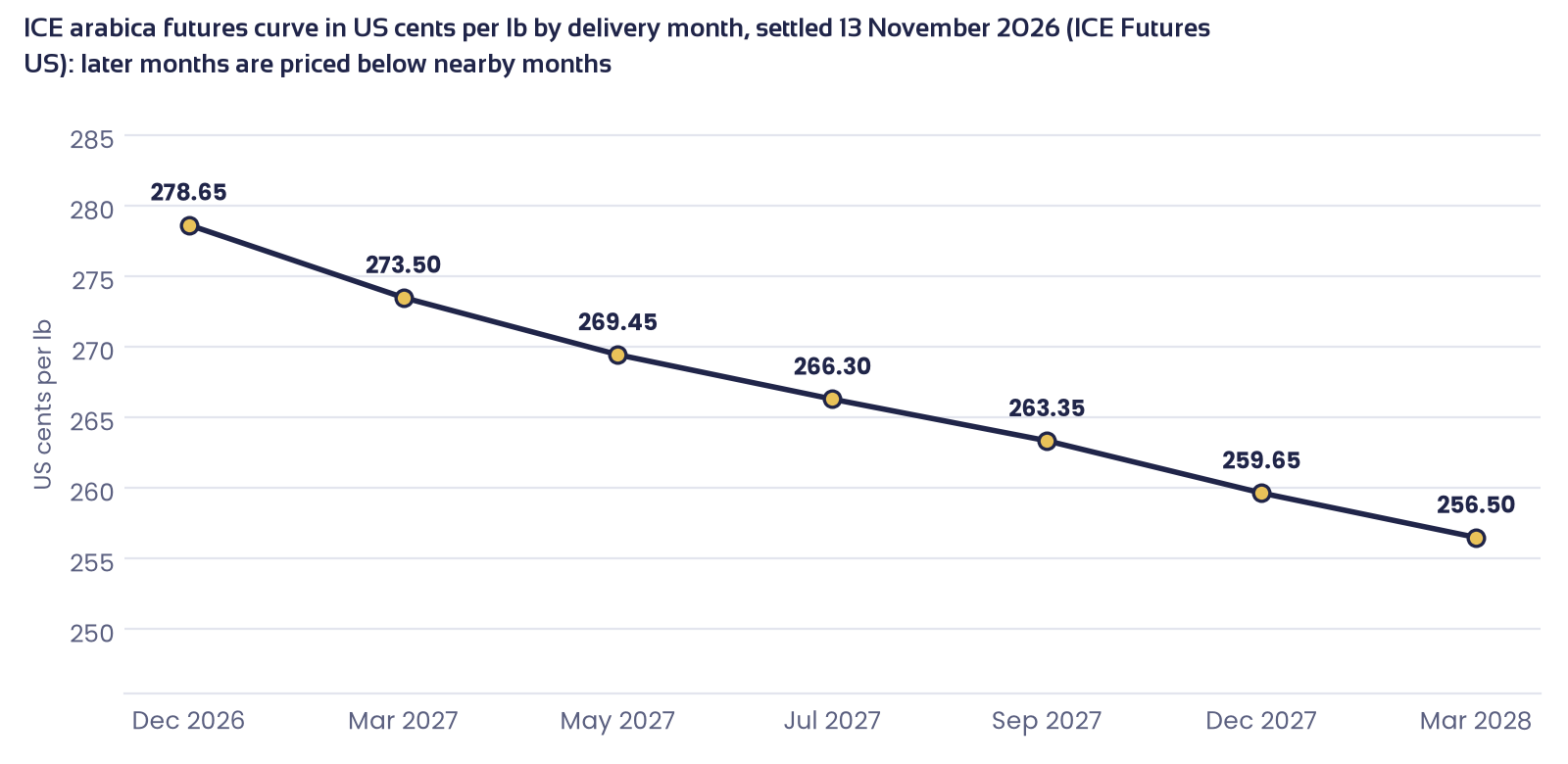
Why scenario B still adds margin. The base averages EUR 2.66 per lb, because the purchases of 13 July 2026 (EUR 2.99 per lb) and 13 August 2026 (EUR 2.89 per lb) were made well above today's price. Today's price is EUR 2.52 per lb, 5.1% lower, so even an unchanged price lowers the cost by 3.7 points of the selling price (ICE Futures US settles, 13 November 2026). The market curve (prices for later months are lower than for nearby months) adds another 1.2 points: +4.9 against +3.7.
The cost structure is an example, not the reader's own: green coffee 72%, energy 3%, packaging 8%, freight and fuel 3%, labour and margin 14% (Terensis cost template for roasted coffee, provisional, 13 November 2026).
4. What should I do now?
Our reading for an example roaster. These are steps that follow from the scenarios, not investment advice.
Price levels that change the call
Open questions the market has not answered yet
- How big is the 2027 Brazilian crop? The latest CONAB figure (1 September 2026) is for the 2026 crop. The next CONAB coffee survey is due on 7 January 2027.
- Will Brazilian shipments stay above 5 million bags in November 2026? Cecafe's daily summary showed 1,224,016 bags shipped by 13 November 2026; the monthly figure follows after the month ends.
- Will certified stocks fall below their 52-week low? The latest figure is 228,586 bags (12 November 2026) against a 52-week low of 217,646 bags; ICE Futures US publishes daily.
| Date | Release | Signals it can change | What would change the call |
|---|---|---|---|
| 25 November 2026 (confirmed) | US personal income and outlays, price index (BEA) | E7 Brazilian real | Past moves of ICE arabica on this release show no reliable effect: +0.24% on average when the print was above 0.278% a month (51 releases), -0.10% when below 0.160% (41 releases). A hotter print that lifts the dollar would weigh on the real (scenario A); a cooler one would ease it (scenario C). |
| 16 December 2026 (confirmed) | USDA coffee: world markets and trade | E5 World stocks, E3 Exports of Brazil | World ending stocks for 2026/27 above 26,283 thousand bags keep E5 pointing to scenario A; a cut below it would turn E5 to scenario C. |
| 7 January 2027 (confirmed) | CONAB coffee survey | E8 Weather, E9 Analogue seasons | An estimate for the coming crop near or above the 67,606 thousand bags of the 2026 crop adds weight to scenario A; one clearly below it adds weight to scenario C. |
Terensis release calendar read on 14 November 2026 (BEA, USDA and CONAB schedules); past reactions from first-release data and ICE Futures US bars.
5. Evidence
| Evidence | Reading | Source and date | Points to |
|---|---|---|---|
| E1 Price trend ↑ | ICE arabica settled at 278.65 US cents per pound (EUR 2.52 per lb) on 13 November 2026, below its 20-day (290.15), 50-day (293.07), 100-day (313.36) and 200-day (301.73) averages. It is down 5.5% in a month and 30.6% in a year. 52-week range: 242.70 (9 June 2026) to 418.45 (18 November 2025). | ICE Futures US, settled 13 November 2026 | A Lower |
| E2 Shape of the futures curve ↑ | Prices for later months are lower than for nearby months: 278.65 for December 2026 against 256.50 for March 2028 (-22.15). The March 2027 against September 2027 spread is -10.15. The exchange data read backwardation as nearby tightness. | ICE Futures US, settled 13 November 2026 | C Higher |
| E3 Exports of the main producer ↑ | Brazil exported a record 5.02 million 60-kg bags of green coffee in October 2026, 31% more than a year earlier (arabica 4.12 million, +22%; robusta about 897,000, doubled). Brazil's Trade Ministry reported 4.79 million bags (+23.3%). Our reading: more shipments mean more supply reaching buyers inside the cover period. Confirmed if November 2026 shipments stay above 5 million bags. | Cecafe via Commodity3, 12 November 2026; Brazil Trade Ministry via Commodity3, 9 November 2026 | A Lower |
| E4 Exchange stocks ↑ | Coffee held in exchange-approved warehouses: 228,586 bags on 12 November 2026, 43.5% below a year earlier and the 4th percentile of records since 2 January 2024 (lowest for the time of year). 52-week range 217,646 to 585,621 bags. Our reading: low deliverable stock tightens nearby supply; it has the shorter horizon of the stock signals. | ICE Futures US, 12 November 2026 | C Higher |
| E5 World stocks ↑ | USDA estimates world ending stocks for 2026/27 at 26.3 million 60-kg bags, up 7.8% on 2025/26 (stocks are 7.8% of use). World output is 189.7 million bags (+6.1%), Brazil 71.9 million (+14.1%). CONAB puts the Brazilian 2026 crop at 67.6 million bags (+19.6%), an on-year. Year definitions: USDA Brazil July to June (2026/27 runs from 1 July 2026 to 30 June 2027); Vietnam and Colombia October to September. | USDA Foreign Agricultural Service, estimate of 1 July 2026; CONAB, 1 September 2026 | A Lower |
| E6 Fund positioning ↑ | Investment funds held 4.3% of open interest net long in arabica on 3 November 2026, 2.4 points less than a week earlier and the 2nd percentile of three years. Producers and merchants were net short 7.9% (96th percentile). Our reading: funds have little length left to sell, so a short-covering rally is possible. | CFTC Commitments of Traders, 3 November 2026 | A Lower |
| E7 Producer currency ↑ | The Brazilian real weakened to 5.6637 per US dollar on 13 November 2026, 12.7% weaker in a month and the weakest in 52 weeks (range 4.9019 to 5.6637). It fell about 9% in one day on 26 October 2026 after the weekend election. The euro is at its 52-week high at 1.1052 US dollars, which lowers the euro cost of a dollar price. Our reading: a weak real speeds Brazilian selling. | ECB reference rates, 13 November 2026; Barchart, 26 October 2026 | A Lower |
| E8 Weather in the growing regions ↑ | Brazil, arabica areas, 1 September 2026 to 13 November 2026: 348 mm of rain against a 30-year median of 245 mm (97th percentile, second wettest of 30 years); mean temperature normal (50th percentile). The flowering window (to 30 March 2027) and the flowering heat-stress window (above 34 degrees Celsius for 3 days, to 30 November 2026) are open. Derived from the flowering rule that a water deficit causes flower abortion: there has been no deficit, which supports flowering and fruit set. Our reading: it softens the risk to the 2027 crop. Vietnam (harvest underway) is normal: rain 30th percentile, mean temperature 80th. Colombia's night temperatures are the warmest of 30 years. | ECMWF and NOAA, AgERA5, IFS and GEFS, 13 November 2026; IAC (Nunes and others, 2010) | A Lower |
| E9 Analogue seasons ↑ | The three past seasons closest to this one on rain and warmth to 31 October 2026 were 2010, 2007 and 1997. They ran at +6.5%, -11.6% and -5.2% of trend yield, on average -3.5%; the most unlike season was 2025. Our reading: a modest shortfall if the season continues like them. The three seasons differ widely and no agency estimate for the 2027 crop exists yet. Vietnam and Colombia matched seasons average -0.7% each. | ECMWF and NOAA, weather to 31 October 2026 | C Higher |
| E10 Arabica minus robusta ↑ | Arabica cost 2,947 US dollars per tonne more than robusta on 13 November 2026, the 13th percentile of 1.6 years (narrow). ICE robusta settled at 3,196 US dollars per tonne (-21.4% in a year). Our reading: at a narrow difference roasters have little reason to move volume from arabica to robusta, which supports arabica demand. | ICE Futures US, 13 November 2026 | C Higher |
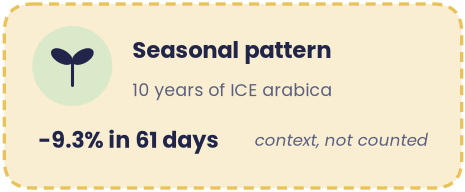
| E11 Seasonal pattern ↑ | In the last 10 years the price moved +2.7% in the 28 days after this date, -9.3% after 61 days and -3.2% after 91 days. It describes other years, so it is context and not counted. | ICE Futures US, 10-year seasonality, 13 November 2026 | Context, not counted |
Terensis reading of the publishers named in each row, data to 13 November 2026.
Other market participants. Citi (via Commodity3, 9 November 2026) is bearish and forecasts ICE arabica at 250 US cents per pound in three months. It agrees with scenario A and is not counted as a signal (Commodity3, 9 November 2026).
El Niño, context and not counted. The IRI forecast of 19 October 2026 calls a very strong El Niño (weekly Niño 3.4 index +3.3 degrees Celsius on 14 October 2026) with a 100% probability of El Niño in every season from the end of 2026 to the northern spring of 2027 and 60% for May to July 2027. Past El Niño years lifted Colombian yields (robust link, +7.3% per degree) and lowered Brazilian yields (suggestive link, not robust at 90%). The links point opposite ways by origin and the realised weather is read first, so this does not count (IRI, Columbia University, 19 October 2026; FAOSTAT yields, Terensis assessment of 6 November 2026).
See the margin impact on your products
Same scenarios, your own cost model.
What are you preparing for?
Cut-off: ICE Futures US settle of 13 November 2026. The cost is valued at the December 2026 contract, the first dated contract after the cut-off; the move is sized with the realised volatility of the current-harvest contracts (December 2026 and March 2027). The base is six equal monthly purchases on 13 June 2026, 13 July 2026, 13 August 2026, 13 September 2026, 13 October 2026 and 13 November 2026. The cost structure is an illustrative example roaster, not the reader's own. Signals are readings of the evidence, not statistical probabilities. Sources: ICE Futures US (arabica and robusta futures, certified stocks, 13 November 2026); CFTC (Commitments of Traders, 3 November 2026); USDA Foreign Agricultural Service (world coffee balance and attache reports, 1 July 2026); CONAB (coffee crop survey, 1 September 2026); Cecafe via Commodity3 (Brazil exports in October 2026, 12 November 2026); Brazil Trade Ministry via Commodity3 (Brazil exports in October 2026, 9 November 2026); Citi via Commodity3 (coffee price view, 9 November 2026); Barchart (coffee market reports, 26 October 2026); CEPEA/ESALQ and ICO (cash prices and price groups, 12 November 2026); IRI, Columbia University; NOAA Climate Prediction Center (El Nino outlook, 19 October 2026); ECMWF and NOAA (AgERA5 reanalysis, IFS and GEFS forecasts, 13 November 2026); European Central Bank (euro and real reference rates, 13 November 2026). Photo: Mike Kenneally, Unsplash; Projeto Café Gato Mourisco, Unsplash.
DISCLAIMER
The information contained in this report is based on data obtained from proprietary, commercial, government and statistical organizations, which Terensis believes to be reliable. While Terensis strives for accuracy, all forecasts, analyses, and assessments or other information in this report are provided "as is" without any warranty of completeness, correctness, applicability or fitness for any specific purpose. In particular, the recipient of this report acknowledges that agricultural, weather, environmental, social and other relevant conditions are inherently uncertain and subject to variables beyond the control of Terensis. Therefore, the recipient assumes full responsibility for any decisions made based on this report. To the fullest extent permitted by law, Terensis excludes all liability for any damages arising in connection with this report. No investment advice.