
Will cocoa cost less, the same or more over the next 12 months than today's GBP 3,832 per tonne?
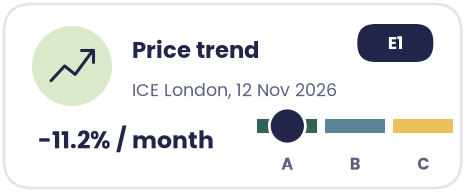
ICE London cocoa settled at GBP 3,832 per tonne (EUR 4,584) on 12 November 2026, 11.2% below its level one month earlier. Five of eight signals point to a lower price, two to the same level and one to a higher price; two give no clear reading.
Short answer
Scenario A (lower) is the most realistic: 5 of 8 signals point to it, 2 to scenario B (same level) and 1 to scenario C (higher). Two more signals give no clear reading and are not counted. This is a share of signals, not a statistical chance.
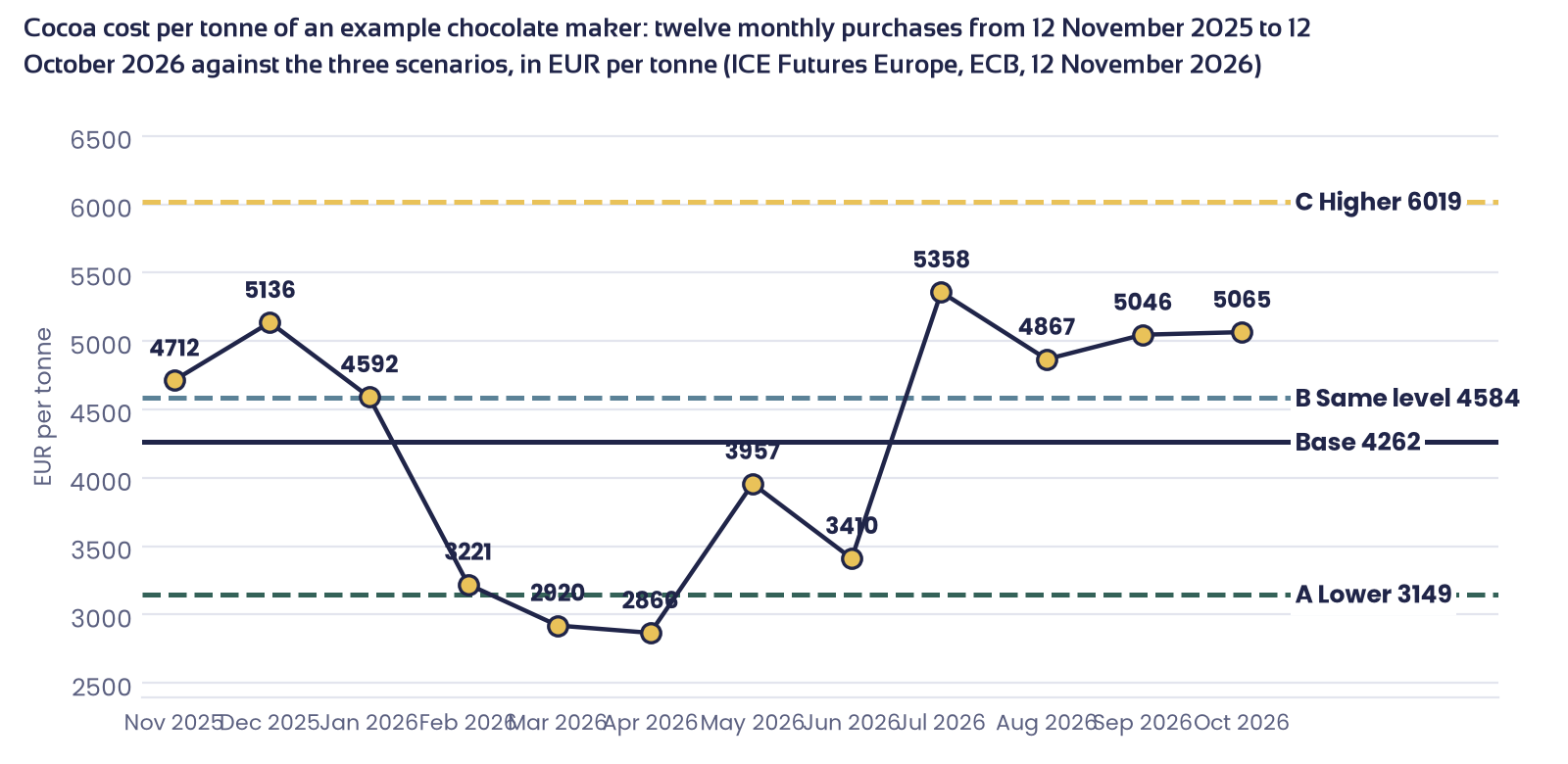
For an example chocolate maker with 35% cocoa in the selling price and 12 months of cover, scenario A adds 9.1 points of margin, scenario B takes away 2.6 points and scenario C takes away 14.4 points. The selling price is assumed unchanged. The cocoa already bought sets a base of EUR 4,262 per tonne (ICE Futures Europe, ECB, 12 November 2026).
Three scenarios for the cocoa price over the next 12 months of purchases
Scenario prices: ICE Futures Europe, settled 12 November 2026, converted at the ECB rate of 12 November 2026. One standard move of 31.3% sizes scenarios A and C. Margin change in points of the selling price for an example chocolate maker; illustrative.
Read the full Margin Call
Leave your email address to read the scenarios in detail, the evidence behind every signal and the cost model, and to download the PDF.
We use your email address to give you access and to follow up on this Margin Call. You can object at any time. More in our privacy policy.
1. Which scenario is most realistic?
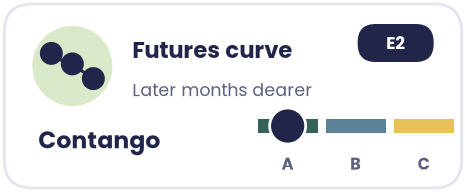
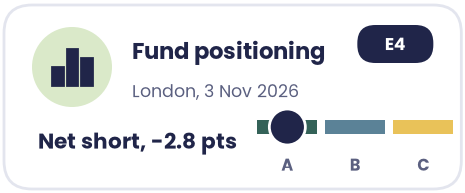
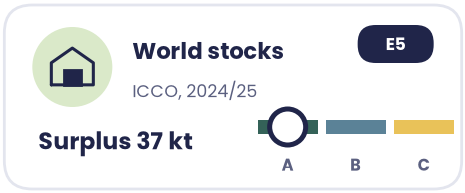
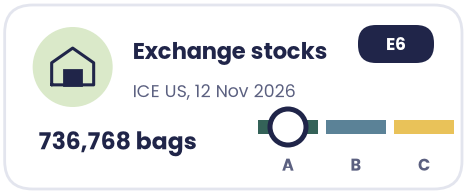
Scenario A (lower) has the most signals: price trend, futures curve, fund positioning, world stocks and exchange stocks. ICE London cocoa settled at GBP 3,832 per tonne (EUR 4,584) on 12 November 2026, 11.2% below one month earlier and below its 20-day, 50-day and 100-day averages of 4,075, 4,172 and 4,210 (ICE Futures Europe, 12 November 2026). Prices for later months are higher than for nearby months, from GBP 3,832 for December 2026 to GBP 3,986 per tonne for March 2027 (ICE Futures Europe, 12 November 2026). Certified cocoa in ICE US warehouses reached 736,768 bags on 12 November 2026, up 100.3% on a year earlier and higher than on 95.4% of days since 4 January 2016 (ICE Futures US, 12 November 2026). The latest ICCO figures show a 2024/25 surplus of 37 kt and ending stocks of 1,309 kt (ICCO, August 2026); our reading is that this points to ample supply, although it describes the previous cocoa year. London funds cut their net position by 2.8 points to 3.8% of open interest short in the week to 3 November 2026 (ICE Futures Europe, 3 November 2026).
The market is rebounding from a low. London cocoa fell 3.8% on 10 November 2026, then rose 3.4% on 11 November 2026 and 2.0% on 12 November 2026 as investment funds bought back bets on lower prices after reports that heavy rain in Ivory Coast damaged roads and disrupted supplies (Barchart, 12 November 2026). Our reading: the rebound is short covering on a transport story, and it has not changed the stock readings.
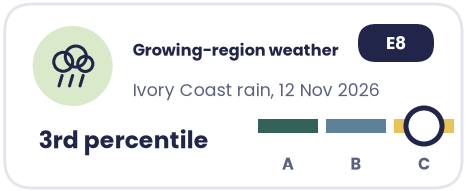
Scenario C (higher) has one signal, the weather, and it is our reading. Ivory Coast's cocoa-growing areas received 1,021 mm of rain from 18 December 2025 to 12 November 2026, against a 30-year median of 1,267 mm for the same days: 19.4% less, the 3rd percentile of 30 seasons (second driest) (ECMWF AgERA5 weather data, 12 November 2026). Mean temperature stood at the 70th percentile, within the normal range. Ghana is near normal at 1,187 mm against a median of 1,290 mm, the 30th percentile (ECMWF AgERA5 weather data, 12 November 2026). This rain fell in the months before the 2026/27 main crop harvest, which runs from 1 October 2026 to 31 March 2027 and supplies the nearest contracts (ICCO cocoa year 2026/27, 1 October 2026 to 30 September 2027). The heavy rain reported on 12 November 2026 is short-term and does not change the season total.
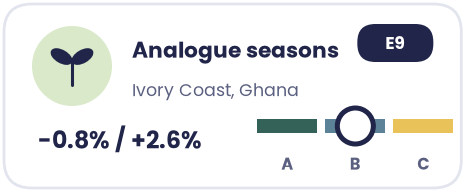
What the weather means: the three past Ivory Coast seasons closest to this one on rain and warmth so far (2020, 2015 and 2009) ran at +0.9%, -1.5% and -1.8% of trend yield, a mean of -0.8%; the least similar season, 2008, ran at +3.4% (Terensis analogue-season analysis, 12 November 2026). The three closest Ghana seasons (2022, 2007 and 2009) ran at +0.2%, +2.9% and +4.8%, a mean of +2.6%. Our reading: the dry season is real in Ivory Coast, but similar past seasons lost almost no yield, so the weather supports scenario C once and the analogue seasons point to a same-level crop. Ivory Coast's national weather agency goes further: an exceptionally strong El Niño could cut 2026/27 production by 21% to 25% (Reuters via Commodity3, 12 November 2026). ICCO's latest release withholds its 2025/26 production figures and gives no 2026/27 estimate, so no crop agency has confirmed or denied a loss (ICCO, August 2026).

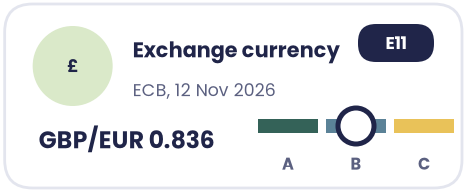

ICE Futures Europe and ICE Futures US, 12 November 2026; CFTC and ICE Futures Europe, 3 November 2026; ICCO, August 2026; ECA and NCA, 30 September 2026; Barchart, 21 October 2026; ECMWF, 12 November 2026; IRI, 19 October 2026; ECB, 12 November 2026.
2. How do the other scenarios answer it?
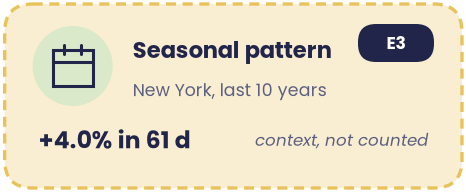
- Scenario B (same level). Two signals point here. Matched seasons show no yield shock: the closest Ivory Coast seasons ran at -0.8% and the closest Ghana seasons at +2.6% of trend yield (Terensis analogue-season analysis, 12 November 2026). The pound moved 0.2% against the euro in a week, so the exchange rate adds almost nothing to the EUR cost (ECB, 12 November 2026). Our reading: a pause is also plausible because funds in New York already hold more bets on falling prices, with their net position at 6.2% of open interest short and at the 14.7th percentile of its history, which leaves less selling to come (CFTC, 3 November 2026). Over the last 10 years ICE New York cocoa gained on average 4.0% in the following 61 days (ICE Futures US, 12 November 2026); that seasonal pattern is context and is not counted.
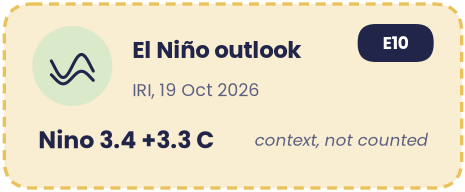
- Scenario C (higher). The El Niño outlook is context for the weather reading and is not counted on its own. The Niño 3.4 index, a sea-surface temperature measure of El Niño strength, reached +3.3 degrees C in the week centred on 14 October 2026, and El Niño probability is 100% for every three-month period from the end of 2026 to the spring of 2027 (IRI, 19 October 2026). For Ivory Coast, 64 years of yield data show yield falling 4.0% per +1.0 degree C of the index, a robust link, and the derived outlook for the 2026 crop is 4.3% below trend (Terensis analysis of FAOSTAT yields, 12 November 2026). What would confirm scenario C: smaller Ivory Coast port arrivals through the main crop harvest to 31 March 2027.
3. What do the scenarios mean for margin?
How the margin effect is calculated
Base: the cocoa cost that is already in the selling price today. It is the average price of equal monthly purchases from 12 November 2025 to 12 November 2026. How to read the numbers: "-2.0" means that of every EUR 100 of sales, EUR 2 less stays as margin. "+1.0" means EUR 1 more stays. The selling price is assumed unchanged.
| Scenario | New cocoa cost, EUR per tonne | Change against base | Margin change, points |
|---|---|---|---|
| A Lower | 3,149 | -26.1% | +9.1 |
| B Same level | 4,584 | +7.5% | -2.6 |
| C Higher | 6,019 | +41.2% | -14.4 |
Terensis cost model for an example chocolate maker, base EUR 4,262 per tonne; ICE Futures Europe, settled 12 November 2026; ECB, 12 November 2026.
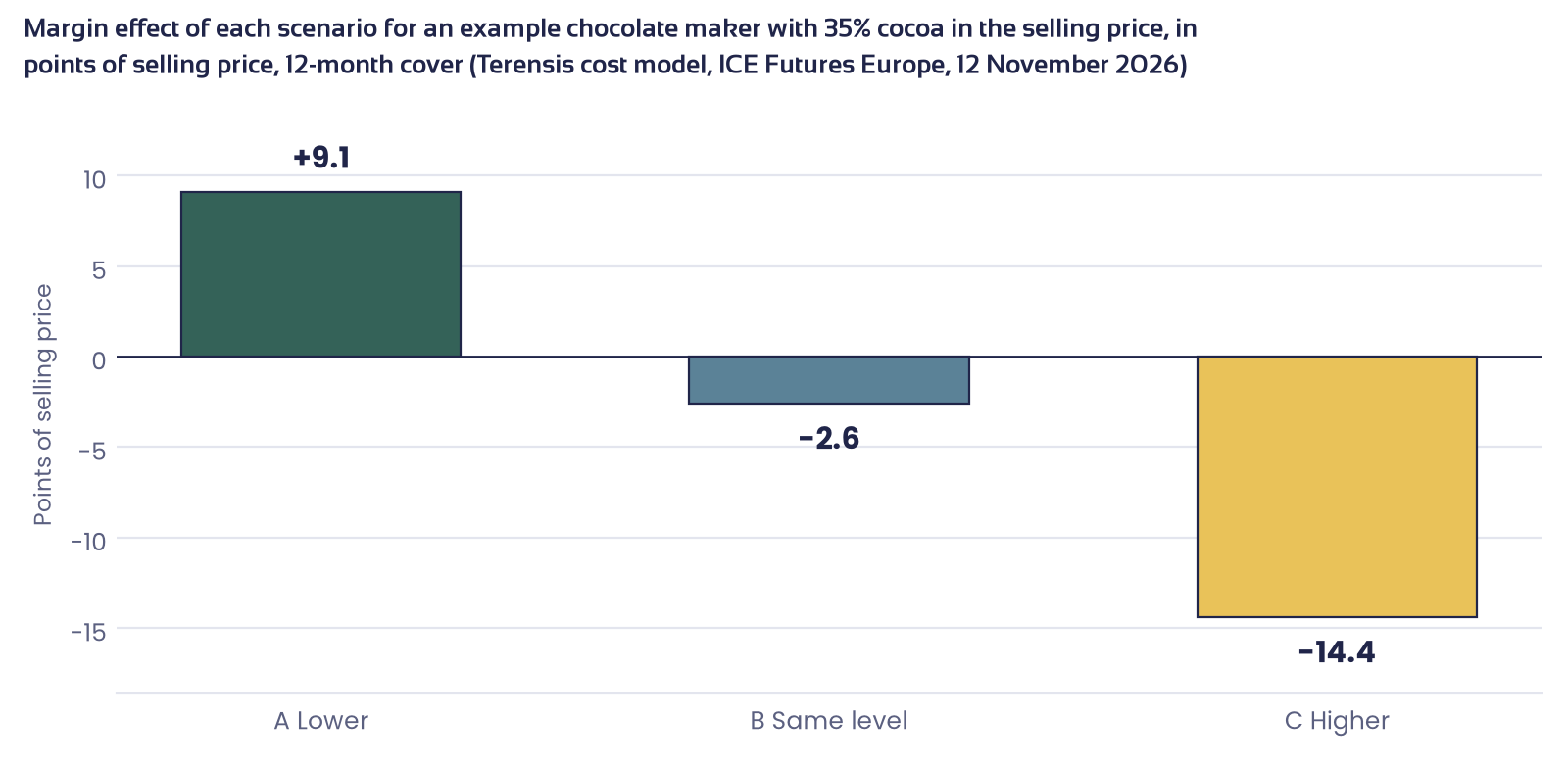
Even scenario B costs margin, because the base of EUR 4,262 per tonne of an example chocolate maker is below today's EUR 4,584 per tonne (ICE Futures Europe, settled 12 November 2026). Cocoa bought on 12 February 2026, 12 March 2026 and 10 April 2026 cost EUR 3,221, EUR 2,920 and EUR 2,866 per tonne, far below the market today.
4. What should I do now?
Cocoa has fallen 11.2% in a month, while Ivory Coast is in a dry season and El Niño is very strong. Scenario C costs more margin than scenario A adds.
Price levels that change the call (ICE London cocoa, settlement)
Open questions the market has not answered yet
- Will funds rebuild or cut bets? The next CFTC report, for the week to 10 November 2026, shows how funds reacted to the 4.5-month low in New York.
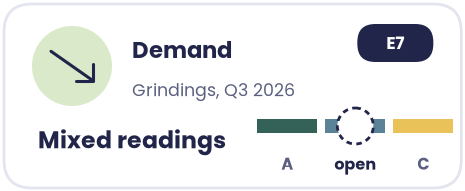
- Does demand hold? European grindings rose 3.2% and North American grindings fell 2.5% in the quarter ending 30 September 2026; the quarter ending 31 December 2026 will show which holds.
- Does Ivory Coast lose a fifth of its crop? The main crop harvest runs to 31 March 2027; port arrivals will show whether the weather agency's 21% to 25% estimate holds.
| Date | Release | Signals it can change | What would change the call |
|---|---|---|---|
| 25 November 2026 | US personal income and outlays, PCE price index, October 2026 (confirmed) | E11 Exchange currency | Past prints above 0.278% or below 0.160% month on month moved ICE cocoa by +0.12% and +0.16% on average (51 and 41 releases): no reliable effect, so it adds no signal on its own. |
| 3 December 2026 | ICCO Quarterly Bulletin of Cocoa Statistics (latest date its cadence allows; not a confirmed date) | E5 World stocks | The last release showed a 2024/25 surplus of 37 kt and stocks of 1,309 kt. A 2025/26 deficit would take the stocks signal away from scenario A; a larger surplus would add to it. |
| 17 January 2027 | ECA and NCA quarterly grindings, quarter to 31 December 2026 (latest dates by cadence: 17 and 20 January 2027) | E7 Demand | The last quarter showed European grindings +3.2% and North American -2.5%. Both falling would add a signal to scenario A; both rising would add one to scenario C. |
Terensis release calendar read on 13 November 2026; ICCO, ECA and NCA schedules as listed there; BEA, release schedule, 13 November 2026.
5. Evidence
| Evidence | Reading | Date and publisher | Points to |
|---|---|---|---|
| E1 Price trend ↑ | GBP 3,832 per tonne; 11.2% below one month earlier; below its 20-day, 50-day and 100-day averages (4,075, 4,172 and 4,210). Direction: bearish. | 12 November 2026, ICE Futures Europe | A Lower |
| E2 Futures curve ↑ | Later months cost more: December 2026 GBP 3,832, March 2027 GBP 3,986, March 2028 GBP 3,969 per tonne. Direction: bearish. | 12 November 2026, ICE Futures Europe | A Lower |
| E3 Seasonal pattern ↑ | Last 10 years of New York cocoa: +7.2% in 28 days, +4.0% in 61 days, +5.3% in 91 days. A statistical pattern, context only. | 12 November 2026, ICE Futures US | context, not counted |
| E4 Fund positioning ↑ | London managed money net 3.8% of open interest short, down 2.8 points on the week, direction bearish. New York net 6.2% short, 14.7th percentile (oversold), direction neutral. London is the benchmark of this call. | 3 November 2026, CFTC and ICE Futures Europe | A Lower |
| E5 World stocks ↑ | 2024/25 surplus of 37 kt; ending stocks 1,309 kt, 28.2% of grindings; production +8.5%, grindings -3.3%. Our reading: ample supply, bearish. It describes the 2024/25 year; ICCO withholds 2025/26. | August 2026, ICCO | A Lower |
| E6 Exchange stocks ↑ | 736,768 bags certified, up 12.8% in a week, 43.0% in four weeks and 100.3% on a year earlier; 96.7% is Latin American cocoa. Our reading: higher deliverable stocks are bearish. | 12 November 2026, ICE Futures US | A Lower |
| E7 Demand ↑ | European grindings +3.2% (348,215 t), the first rise in the eight quarters reported; North American -2.5% (109,978 t, reporting panel changed); European 2025/26 year -4.4%. The readings differ. | 30 September 2026, ECA and NCA | Open |
| E8 Growing-region weather ↑ | Ivory Coast rain 1,021 mm since 18 December 2025 against a 30-year median of 1,267 mm, 3rd percentile of 30; Ghana 1,187 mm against 1,290 mm, 30th percentile; Ghana dry-season window open from 1 November 2026 to 28 February 2027. Our reading: less pod set, bullish. | 12 November 2026, ECMWF AgERA5 and Terensis crop-stage windows | C Higher |
| E9 Analogue seasons ↑ | Closest Ivory Coast seasons 2020, 2015, 2009: mean -0.8% of trend yield; closest Ghana seasons 2022, 2007, 2009: mean +2.6%. Our reading: no yield shock, neutral. Matched seasons, not a forecast. | 12 November 2026, Terensis analogue-season analysis | B Same level |
| E10 El Niño outlook ↑ | Niño 3.4 +3.3 degrees C; El Niño probability 100% for every three-month period from the end of 2026 to the spring of 2027. Ivory Coast yield link -4.0% per degree C. A statistical link, context only. | 19 October 2026, IRI; 15 October 2026, NOAA | context, not counted |
| E11 Exchange currency ↑ | GBP per EUR 0.836 on 12 November 2026; the pound lost 0.2% against the euro in a week. Our reading: neutral for the EUR cost. | 12 November 2026, ECB | B Same level |
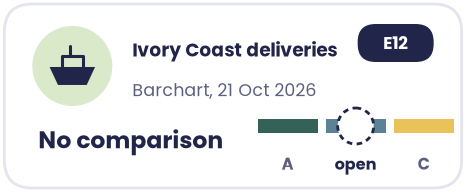
| E12 Ivory Coast deliveries ↑ | Smaller Ivory Coast deliveries were reported on 19 October 2026; no later delivery or port-arrival figure with a comparison was published in the weeks to 12 November 2026, so there is no direction to read. | 21 October 2026, Barchart | Open |
ICE Futures Europe, ICE Futures US, CFTC, ICCO, ECA, NCA, ECMWF, IRI, NOAA Climate Prediction Center, ECB and Barchart, readings dated as shown, 2026.
| Cost component of an example chocolate maker | Share of selling price | Change in the scenarios |
|---|---|---|
| Cocoa | 35% | Moves with the scenario |
| Sugar | 15% | None |
| Dairy ingredients | 10% | None |
| Energy | 4% | None |
| Packaging | 8% | None |
| Labour and margin | 28% | None |
Terensis chocolate cost template, illustrative shares for an example buyer, 12 November 2026.
See the margin impact on your products
Same scenarios, your own cost model.
What are you preparing for?
The cost structure is an example chocolate maker and is illustrative; it is not the reader's own. Only the cocoa price moves in the scenarios; sugar, dairy, energy, packaging, labour and margin stay at today's level. One standard move is 31.3%: the 20-day realised volatility of the ICE London main-crop contracts (December 2026, March 2027, December 2027 and March 2028) on 12 November 2026 times the square root of 12 months over 12. The same-level price is the settlement of the December 2026 contract, GBP 3,832 per tonne, converted to EUR 4,584 per tonne at the ECB rates of 12 November 2026 (1.196 EUR per GBP). The base is twelve equal monthly purchases from 12 November 2025 to 12 October 2026, valued on the ICE London front-month continuous series. 1 t = 2,204.62 lb. Direction labels (bearish, neutral) are the data provider's provisional labels. Our reading marks a judgement. Context rows are shown and not counted. Sources: ICE Futures Europe (London cocoa settlements, 12 November 2026); ICE Futures US (New York cocoa settlements and certified stocks, 12 November 2026); CFTC (Commitments of Traders, 3 November 2026); ICCO (Quarterly Bulletin of Cocoa Statistics, August 2026); ECA and NCA (European and North American cocoa grindings, 30 September 2026); ECMWF (AgERA5 weather data for Ivory Coast and Ghana, 12 November 2026); IRI, Columbia University (ENSO Quick Look, 19 October 2026); NOAA Climate Prediction Center (ENSO discussion, 15 October 2026); ECB (euro reference rates, 12 November 2026); Barchart (cocoa market report, 12 November 2026); Commodity3 (Reuters report on Ivory Coast and El Niño, 12 November 2026). Photo: Kawe Rodrigues, Unsplash; Ly Le Minh, Unsplash.
DISCLAIMER
The information contained in this report is based on data obtained from proprietary, commercial, government and statistical organizations, which Terensis believes to be reliable. While Terensis strives for accuracy, all forecasts, analyses, and assessments or other information in this report are provided "as is" without any warranty of completeness, correctness, applicability or fitness for any specific purpose. In particular, the recipient of this report acknowledges that agricultural, weather, environmental, social and other relevant conditions are inherently uncertain and subject to variables beyond the control of Terensis. Therefore, the recipient assumes full responsibility for any decisions made based on this report. To the fullest extent permitted by law, Terensis excludes all liability for any damages arising in connection with this report. No investment advice.