

Will wheat hold near EUR 233 while Black Sea ships are under fire?
Will milling wheat cost more, less or the same in three months?
An example miller buys wheat three months ahead. Euronext milling wheat settled at EUR 236.75 per tonne (December 2026 contract) on 20 November 2026; the March 2027 contract that carries the quarter settled at EUR 233.00. Where it stands on 19 February 2027 sets the margin.
Since last week
The question is unchanged. Euronext milling wheat (December 2026 contract) rose from EUR 233.50 per tonne on 13 November 2026 to EUR 236.75 on 20 November 2026. The December 2026 contract is close to expiry, so the quarter is now valued on the March 2027 contract (EUR 233.00). The count of signals moved from 5 B, 4 C and 3 A of 12 in week 2026-W47 (16 November 2026) to a tie of 5 for scenario B and 5 for scenario C, with 3 for scenario A, of 13, because Black Sea shipping attacks, a curve in backwardation and rising fund length now point up, while rain in Russia and France recovered to normal. The margin effects are +9.4, +2.7 and -4.0 points (last week +9.5, +1.9 and -5.8).
Short answer
A tie: scenario B (the price stays near EUR 233.00 per tonne) and scenario C (higher price) have 5 of 13 signals each, 3 point to scenario A (lower price). This is a share of signals, not a statistical chance.
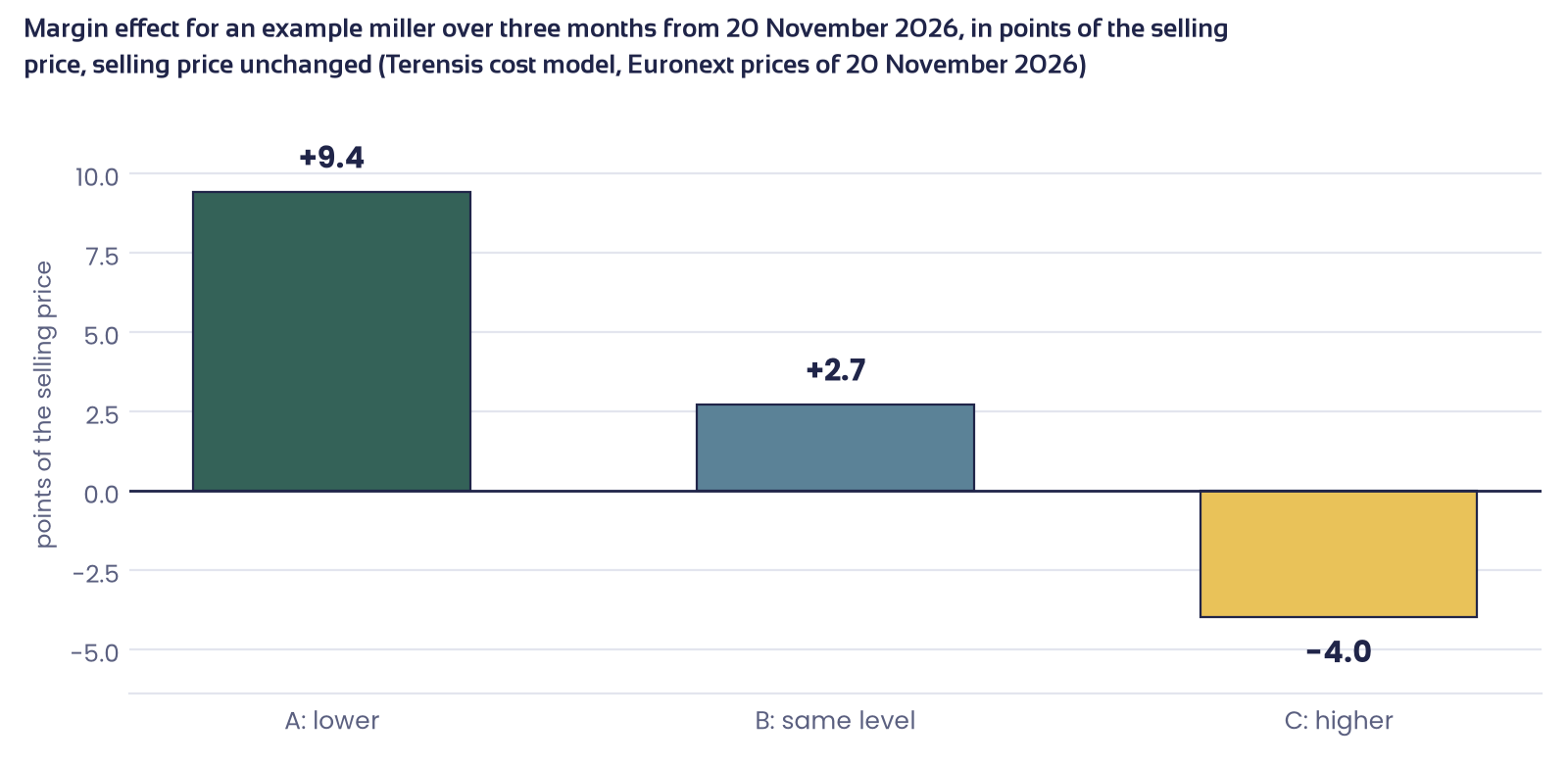
For an example miller with a three-month cover, today's price is 3.9% below the wheat cost already in the selling price, so an unchanged market lifts the margin by 2.7 points if the selling price stays. A move of one standard step, about EUR 23.18 per tonne, would give +9.4 points (lower) or -4.0 points (higher).
The tie is broken by the USDA world balance on 10 December 2026 (projected date) and by whether Black Sea shipping resumes.
Three scenarios for the Euronext milling wheat price on 19 February 2027
Share of signals, not a statistical chance. Prices: Euronext settlement of the March 2027 contract on 20 November 2026 (EUR 233.00), plus or minus one standard step of 9.95%. Margin effect in points of the selling price for an example miller, selling price unchanged. Illustrative cost structure.
Read the full Margin Call
Leave your name and email address to read the scenarios in detail, the evidence behind every signal and the cost model, and to download the PDF.
We use your name and email address to give you access and to follow up on this Margin Call, and we note which link brought you here. You can object at any time. More in our privacy policy.
1. Which scenario is most realistic?
Of the 13 signals with a current reading, 5 point to scenario B (same price) and 5 to scenario C (higher price), a tie, and 3 to scenario A (lower price), on readings to 20 November 2026. Signals marked as our reading are judgement; the others follow the direction the data states. One tile is context and not counted: a seasonal pattern of other years.


Euronext, CFTC, USDA, COCERAL, MAGyP, FranceAgriMer, ECMWF, European Commission, ECB and Commodity3, readings to 20 November 2026.
Why B and C tie. The price sits at its 20-day high of EUR 239.25 but level with its 50-day average (EUR 236.74), weather in the growing regions is normal, EU exports run 1.1% above the same weeks of 2025/26 and the Rouen basis is normal (5 signals for B). Against that, the curve is in backwardation, funds added length, the dollar is strong, the 2026 EU crop is 7.6% smaller and Black Sea ships and ports are under attack (5 signals for C). World stocks, cheap Chicago wheat and large southern harvests lean down (3 signals for A).
What the headline hides. World ending stocks of 280.8 Mt include China and Black Sea stocks that do not reach the export market. The Algerian price of about USD 313 per tonne includes freight and is a single trade estimate. Euronext funds are 5.27% net long, which is the 81st percentile of three years, so their length is stretched and can be cut quickly.
What would break the tie. World ending stocks above 280.8 Mt in the USDA report of 10 December 2026, or a resumption of Black Sea loadings, would move weight to scenario B or A; a further cut of Russian or Ukrainian exports below 39.0 Mt and 11.5 Mt, or another attack on shipping, would move weight to scenario C.
2. How do the other scenarios answer it?
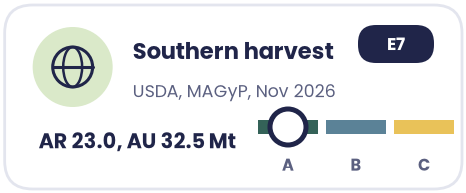
- Scenario A: lower price (3 of 13 signals). USDA raised world ending stocks by 4.8 Mt to 280.8 Mt on 10 November 2026 and Argentina and Australia by 1.5 Mt each to 23.0 Mt and 32.5 Mt, and Chicago soft red winter wheat is USD 49.19 per tonne below Euronext, the 3rd percentile of 10.2 years. Scenario A needs Euronext to close that difference from above: Southern Hemisphere harvests and a quiet Black Sea would do it. It is confirmed if the March 2027 contract settles at or below about EUR 210 per tonne on 19 February 2027.
- Scenario C: higher price (5 of 13 signals). A sea-drone strike sank a wheat cargo ship off Bulgaria on 16 November 2026, the Kerch Strait bridge arch fell on 17 November 2026, Ukraine's agriculture minister said the 2027 harvest could halve to 30 Mt from 62 Mt if ports stay closed, the curve is in backwardation (-2.0%), Euronext funds added 4.2 points of net length in a week and the 2026 EU soft wheat crop is 7.6% smaller than the previous season. Scenario C needs the Black Sea to stay restricted and funds to keep buying. It is confirmed if the March 2027 contract settles at or above about EUR 256 per tonne on 19 February 2027.
Winter wheat is dormant or just emerging in November 2026, so the weather signal is a risk to crop establishment, not a yield loss. Analogue seasons, the past years that ran like this one, can only be matched from March 2027.
3. What do the scenarios mean for margin?
Base
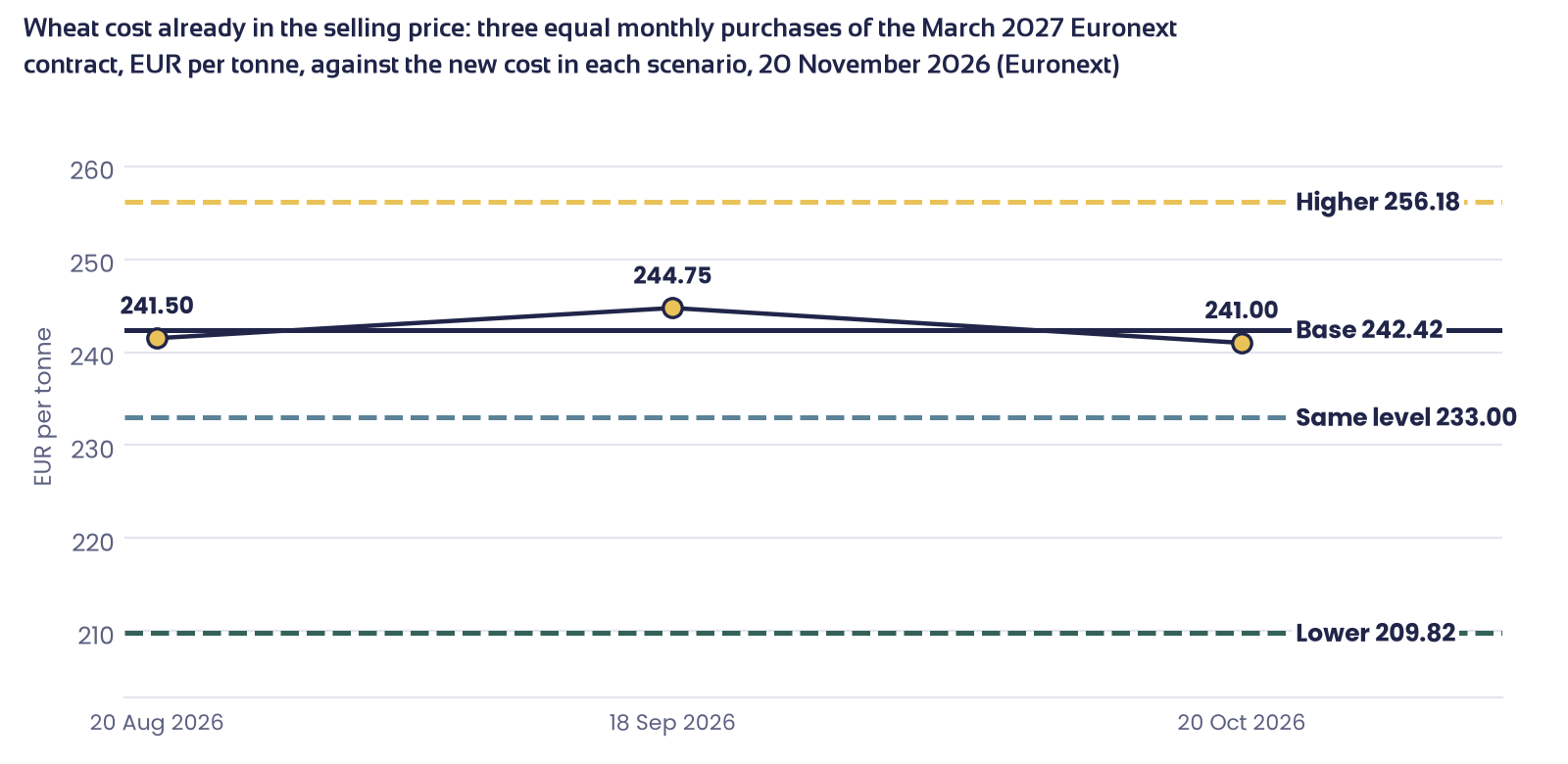
Base: the wheat cost that is already in the selling price today. It is the average price of equal monthly purchases from 20 August 2026 to 20 November 2026. How to read the numbers: "-2.0" means that of every EUR 100 of sales, EUR 2 less stays as margin. "+1.0" means EUR 1 more stays. The selling price is assumed unchanged.
| Scenario | Wheat price assumed, EUR per tonne | Change in wheat cost against the base | Margin effect, points of the selling price |
|---|---|---|---|
| A Lower | 209.82 (one standard step below) | -13.5% | +9.4 |
| B Same level | 233.00 (settlement of 20 November 2026) | -3.9% | +2.7 |
| C Higher | 256.18 (one standard step above) | +5.7% | -4.0 |
Terensis cost model for an example miller (wheat 70% of the price, other costs 30%), Euronext prices of 20 November 2026. Illustrative.
Why the three margin figures differ. The scenarios move today's price by the same step in both directions: 9.95%, the typical size of price swings over the three months of cover (about EUR 23.18 per tonne). The margin is measured against the base of EUR 242.42 per tonne that is already in the selling price (equal purchases over the last 3 months), not against today's price. That is why the same-level scenario adds margin (today's price is 3.9% cheaper than the base), why a fall saves more margin than a rise of the same size costs (13.5% cheaper against 5.7% dearer), and why the figures scale with the wheat share of 70% in the selling price: 13.5% of 70% is 9.4 points. (Terensis cost model, 20 November 2026)
The base cost is EUR 242.42 per tonne: three equal monthly purchases of the March 2027 contract at EUR 241.50 (20 August 2026), EUR 244.75 (18 September 2026) and EUR 241.00 (20 October 2026). Today's price of EUR 233.00 is EUR 9.42 below it, so even an unchanged market lowers the wheat cost by 3.9%.
One standard step is the typical size of price swings over the cover period: 19.9% a year for the stored-crop contracts over the 20 days to 20 November 2026, times the square root of 3/12, gives 9.95%, or EUR 23.18 per tonne on EUR 233.00. This is a fixed rule, not a forecast. Only the wheat price moves; energy, freight, labour, packaging and margin stay at today's level.
4. What should I do now?
Scenarios B and C tie, and a move of one standard step in three months is normal for this market. These are options to weigh, not advice.
Price levels that change the call
Open questions the market has not answered yet
- Will Black Sea shipping resume? Russian and Ukrainian exports of 39.0 Mt and 11.5 Mt in the USDA report of 10 December 2026 (projected date) against the cuts of 1.0 Mt each on 10 November 2026.
- Will funds keep adding length? Euronext funds at 5.27% net long (81st percentile) in the next Commitment of Traders reports.
- Will USDA raise world stocks again? The USDA report of 10 December 2026 (projected date) against 280.8 Mt.
- Will EU winter wheat establish well? The JRC MARS bulletin expected by 4 December 2026 on soil moisture in France and Germany.
| Date | Release | Signals it can change | What would change the call |
|---|---|---|---|
| 23 November 2026 | USDA Crop Progress (confirmed) | E8 Sowing progress | US winter wheat rated below 53% good or excellent would add weight to scenario C; above 53% supports scenarios B and A. |
| 25 November 2026 | US PCE inflation (confirmed) | E13 Euro against the dollar | A print above 0.278% a month (past Euronext moves -0.33% on average, 54 releases) or below 0.16% (+0.11%, 43 releases) has shown no reliable effect; only a lasting move of the euro changes E13. |
| 4 December 2026 | JRC MARS bulletin (expected by this date) | E8 Sowing progress, E9 Weather | Low soil moisture confirmed for French or German winter wheat adds weight to scenario C; recovered moisture adds weight to scenario B. |
| 10 December 2026 | USDA WASDE (projected date) | E5 World stocks, E6 EU harvest, E7 Southern harvest | World ending stocks above 280.8 Mt add weight to scenario A (stocks were materially revised in 4 of 10 past years, 30% up and 10% down); a cut below 280.8 Mt moves E5 to scenario C. |
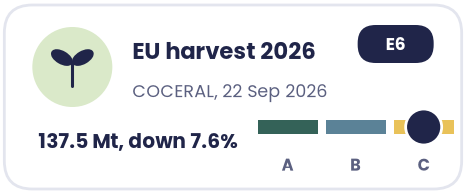
| 20 January 2027 | COCERAL crop forecast (expected by this date) | E6 EU harvest | A figure above 137.5 Mt for the 2026 EU soft wheat crop would ease E6 toward scenario B; a lower figure adds weight to scenario C. |
Upcoming releases that can change the call: Terensis release calendar read on 23 November 2026 (USDA, ECB and BEA schedules; JRC MARS and COCERAL dates are upper bounds).
5. Evidence
| Evidence | Reading | Source and date | Points to |
|---|---|---|---|
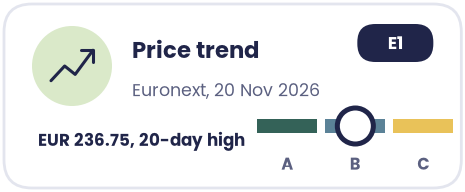
| E1 Price trend ↑ | Our reading: Euronext milling wheat (December 2026 contract) settled at EUR 236.75 per tonne on 20 November 2026, at its 20-day high (EUR 239.25) and between its 100-day average (EUR 232.20) and its 200-day average (EUR 216.46), level with its 50-day average (EUR 236.74) and above its 20-day average (EUR 230.03). It rose 1.4% in the week and 1.1% in the month and is 25.1% above a year ago; 52-week range EUR 179.75 (11 May 2026) to EUR 249.75 (2 September 2026). A weak trend (ADX 20.4) with the price at the 50-day average points to an unchanged price. | Euronext, settled 20 November 2026 | B Same level |
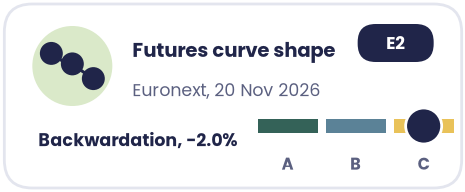
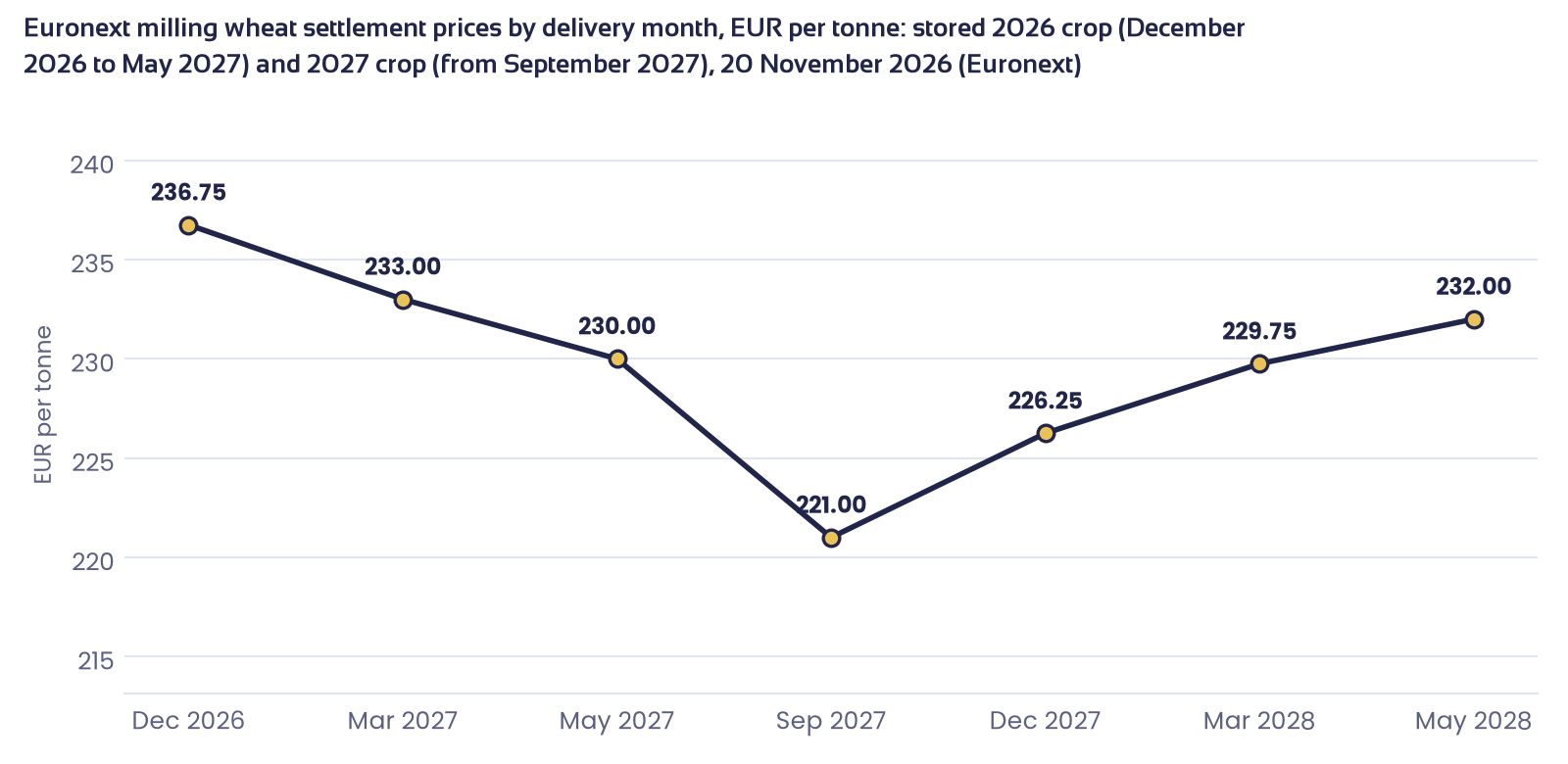
| E2 Shape of the futures curve ↑ | Prices for later months are lower than for nearby months: December 2026 EUR 236.75, March 2027 EUR 233.00, May 2027 EUR 230.00, September 2027 EUR 221.00. The slope from the nearest to the furthest contract is -2.0% (backwardation, bullish). The 2027 crop (September 2027) trades EUR 9.00 below the May 2027 contract of stored wheat (-3.9%), a sign of tight nearby supply. | Euronext, settled 20 November 2026 | C Higher |
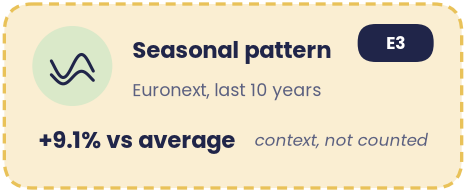
| E3 Seasonal pattern ↑ | Context, not counted: in the last 10 years the price stood 9.1% above its average for this date (79th percentile); in those years the following 28, 61 and 91 days moved -0.2%, -2.1% and -2.3% on average. This describes other years, not this season. | Euronext, 20 November 2026 | Context, not counted |
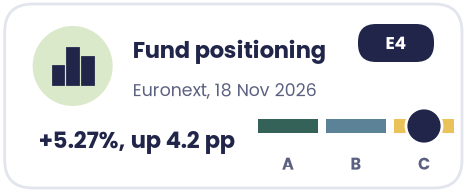
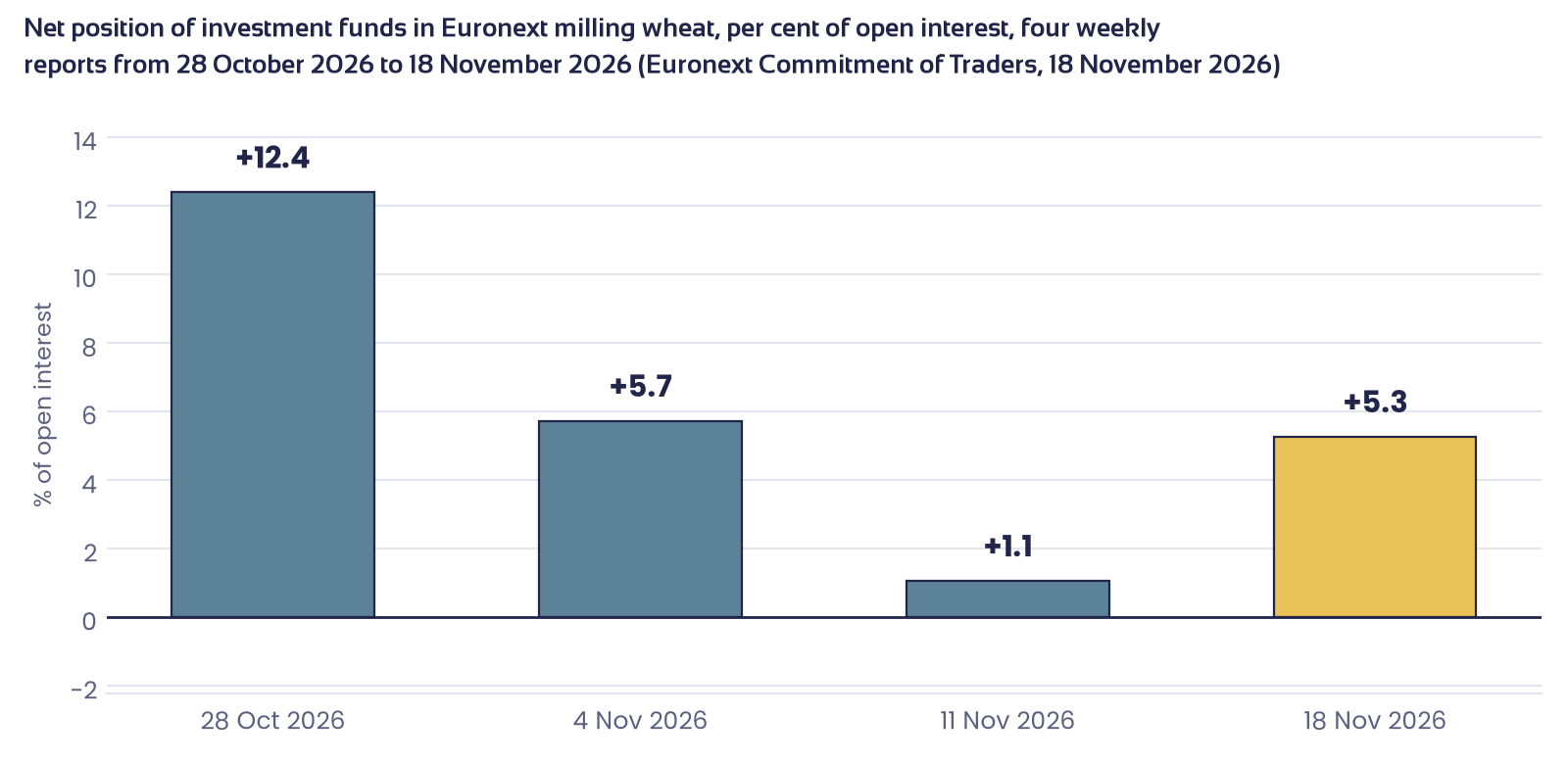
| E4 Fund positioning ↑ | Investment funds in Euronext milling wheat held 5.27% of open interest net long on 18 November 2026 (81st percentile of three years, overbought), 4.2 points higher in a week but 7.1 points lower than on 28 October 2026 (12.4%). Funds in Chicago soft red winter wheat were 12.2% net short on 17 November 2026, unchanged within 0.2 points. Funds adding length is bullish. | Euronext and CFTC, 18 November 2026 and 17 November 2026 | C Higher |
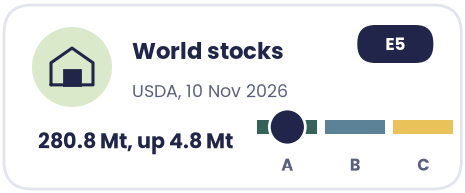
| E5 World stocks ↑ | USDA raised 2026/27 world wheat ending stocks by 4.8 Mt to 280.8 Mt; world production of 827.5 Mt is at the 98.5th percentile since 1960. Stocks-to-use is 33.9% against 34.4% in 2025/26 (0.6 points lower, which alone would read as bullish), but the freshest revision, higher stocks, is bearish and decides the reading. Russian and Ukrainian exports were each cut 1.0 Mt to 39.0 and 11.5 Mt. | USDA, WASDE of 10 November 2026 | A Lower |
| E6 EU harvest 2026 ↑ | COCERAL puts the 2026 soft wheat crop of the EU-27 and the United Kingdom at 137.5 Mt, 7.6% below the previous season and 2.4% below its July 2026 edition (France 31.9 Mt, Germany 20.7 Mt, Romania 13.4 Mt). The 2026 crop is harvested and stored, so it speaks through the stocks that the December 2026 to May 2027 contracts ration. Smaller stocks are bullish. | COCERAL, 22 September 2026 | C Higher |
| E7 Southern harvest 2026/27 ↑ | Our reading: USDA raised the Argentine wheat crop by 1.5 Mt to 23.0 Mt and the Australian crop by 1.5 Mt to 32.5 Mt on 10 November 2026. Argentina's ministry reported on 19 November 2026 good soil moisture and expected yields above average, with first harvest results of 35 to 45 quintals per hectare (3.5 to 4.5 t/ha) in Córdoba and Santa Fe. Argentine FOB wheat is USD 218.00 per tonne (19 November 2026), USD 45.78 below Rouen; the quality is unverified and the location differs. Large southern crops compete for export business from December 2026 to March 2027, which is bearish. | USDA, 10 November 2026; MAGyP, 19 November 2026; BCR, 19 November 2026 | A Lower |
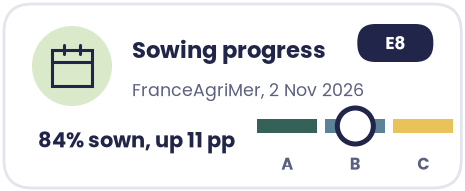
| E8 Sowing progress ↑ | Our reading: French soft wheat sowing reached 84% on 2 November 2026, 11 points ahead of the 5-year average, and emergence 48%, 1 point behind it. US winter wheat is 92% planted (5-year average 94%), 82% emerged (5-year average 81%) and rated 53% good or excellent, 4 points higher in a week and 7.6 points above its 5-year average. The 2027 crop starts on a normal pace; no condition rating exists yet for French wheat. JRC MARS reported low soil moisture hampering establishment in France and southern Germany, which the weather row counts. | FranceAgriMer, 2 November 2026; USDA NASS, week to 15 November 2026; JRC MARS, 26 October 2026 | B Same level |
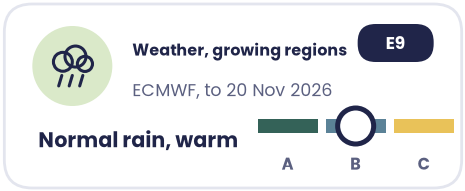
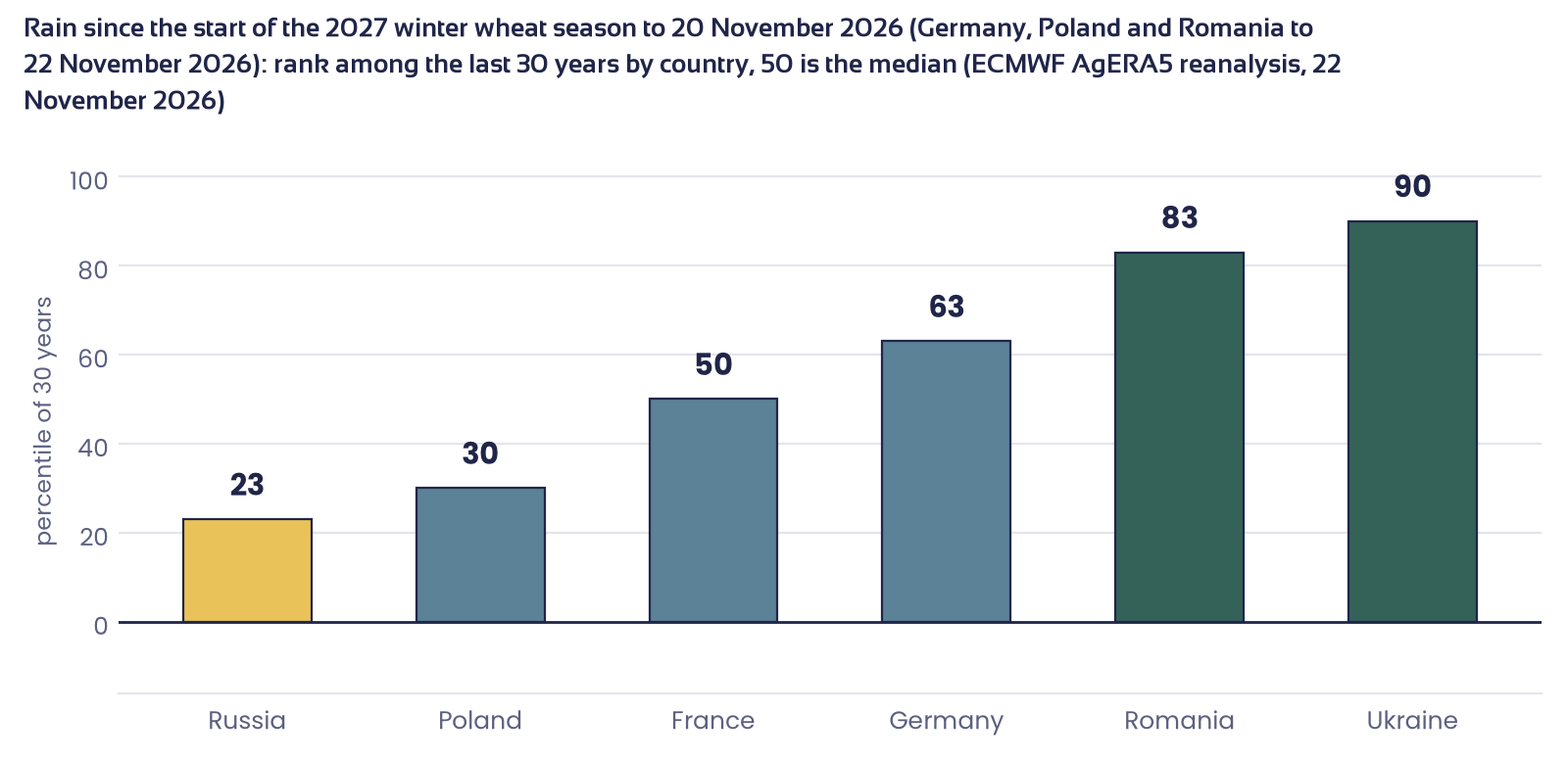
| E9 Weather in the growing regions ↑ | Our reading: from 1 October 2026 to 20 November 2026 Russian winter wheat areas received 62.5 mm of rain, the 23rd percentile of 30 years, in the warmest autumn of the 30 years (mean temperature 8.0 °C against a median of 5.6 °C). France received 132.9 mm (50th percentile) and Ukraine 102.2 mm (90th, fourth wettest). Poland (30th percentile), Germany (63rd) and Romania (83rd) are measured from their own season start between 26 September 2026 and 3 October 2026 to 22 November 2026. Winter wheat is dormant or emerging, so this is a risk to establishment, not a yield loss; derived from the 30-year range. No yield-sensitive window is open: the French heat and Fusarium windows start on 15 May 2027. Rain is normal to ample almost everywhere, which removes the dry-autumn concern of the report of 16 November 2026. | ECMWF AgERA5 reanalysis, 20 November 2026 and 22 November 2026; JRC MARS, 26 October 2026 | B Same level |
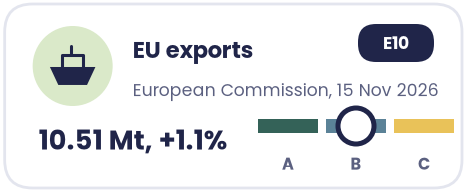
| E10 Exports and trade flows ↑ | Our reading: EU soft wheat exports reached 10.51 Mt from 1 July 2026 to 15 November 2026, 1.1% above the same weeks of 2025/26, 14.5% above 2024/25 and 17.0% below 2023/24; the latest week (9 to 15 November 2026) was 330,596 t, the lowest of the last eight weeks. Imports are 1.20 Mt, 33.6% below 2025/26. The European Commission notes that French export data have been incomplete since 2024, so the total is understated. An export pace equal to 2025/26 neither tightens nor loosens the market. | European Commission, customs surveillance, 15 November 2026 | B Same level |
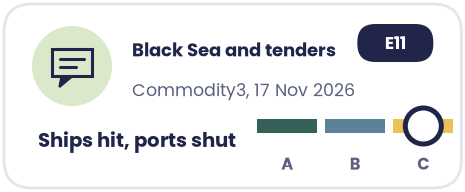
| E11 Black Sea and importer tenders ↑ | Our reading: a sea-drone strike sank a wheat cargo ship off Bulgaria on 16 November 2026; the Kerch Strait bridge arch fell on 17 November 2026; the Azov Sea remains closed and most shipowners avoid Black Sea ports (freight report, 19 November 2026); Ukraine's agriculture minister said on 17 November 2026 that the 2027 grain harvest could halve to 30 Mt from 62 Mt. FranceAgriMer raised its forecast of French soft wheat exports outside the EU to 7.2 Mt on 18 November 2026 as demand shifts to French supply. Algeria's state buyer is reported to have bought more than 700,000 t of milling wheat at about USD 313 per tonne including cost and freight on 11 November 2026, which is USD 49.22 above Rouen FOB (USD 263.78 on 18 November 2026); freight is part of the difference and cannot be separated. Disrupted exports and importers paying up for supply support the export price. Prices and volumes of tenders are trader estimates. | Commodity3, traders cited by Reuters, 12 November 2026, 16 November 2026, 17 November 2026 and 19 November 2026 | C Higher |
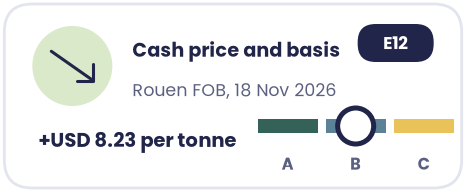
| E12 Cash price and basis ↑ | Our reading: Rouen FOB wheat (grade 1) is USD 8.23 per tonne above the Euronext front month on 18 November 2026, the 72nd percentile of 7.8 years (normal) and USD 4.29 wider than a week earlier. French delivered-port bread wheat was EUR 1.07 above the front month on 2 November 2026 (48th percentile). A normal basis shows neither tight nor ample physical supply, although it is near the top of its normal band. German farm-gate bread wheat was EUR 180.00 per tonne on 18 November 2026, EUR 3.00 higher in a week. | European Commission, 18 November 2026 and 2 November 2026; Euronext; German LEL, 18 November 2026 | B Same level |
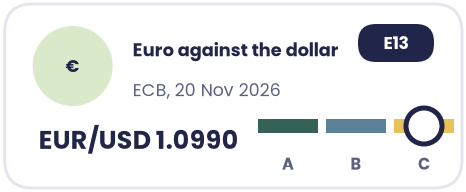
| E13 Euro against the dollar ↑ | Our reading: EUR/USD stood at 1.0990 on 20 November 2026. The dollar gained 0.6% against the euro in a week and 2.2% in a month, is 4.8% stronger than a year ago and is close to its strongest level in 52 weeks. Dollar-priced wheat from the Black Sea and the United States costs more in euros, which is bullish for Euronext. | ECB, 20 November 2026 | C Higher |
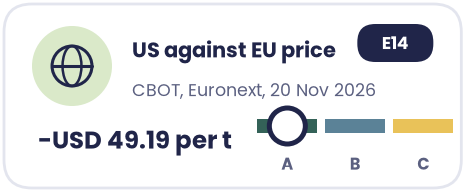
| E14 US against EU price ↑ | Our reading: Chicago soft red winter wheat is USD 49.19 per tonne below Euronext milling wheat (20 November 2026), the 3rd percentile of 10.2 years and USD 9.11 lower than a week earlier. Chicago fell 8.1% in a month to 574.25 cents per bushel (CBOT, settled 20 November 2026) and 3.2% in the week. Different qualities and delivery points make this a market spread, not a like-for-like price. A cheap world price pulls the EU benchmark down. | Chicago Board of Trade and Euronext, 20 November 2026 | A Lower |
| E15 Analogue seasons ↑ | Open: analogue seasons, the past years that ran like this one on rain and temperature, can only be matched from March 2027; the 2027 winter wheat season is weeks old. It does not decide now and will be read in March 2027. | Terensis, to be read in March 2027 | Open: not before March 2027 |
Readings to 20 November 2026; publishers as named in each row. Our reading marks a direction taken by judgement.
| Cost component of an example miller | Share of the selling price | Assumption in the scenarios |
|---|---|---|
| Milling wheat | 70% | Valued at Euronext milling wheat, March 2027 contract; base EUR 242.42 per tonne |
| Energy, freight, labour, packaging and margin | 30% | Unchanged against today |
Terensis cost model template for wheat flour, 23 November 2026. Shares are illustrative starting points, not industry data.

See the margin impact on your products
Same scenarios, your own cost model.
What are you preparing for?
Notes: prices are Euronext milling wheat settlements unless stated. The wheat cost of an example miller is valued on the March 2027 contract (2026 harvest, stored supply), the first dated contract that expires more than one month after the cut-off, in both periods, and one standard step (19.9% a year times the square root of 3/12 = 9.95%) is taken from the same stored-supply contracts over the 20 days to 20 November 2026. Only the wheat price moves; energy, freight, labour, packaging and margin stay at today's level. A market-curve check differs from scenario B by less than 0.5 points and is not shown. The cost structure is illustrative. USD figures are exchange and trade quotes and are not converted unless stated; tender prices are trader estimates. Our reading marks judgement. Sources: Euronext (milling wheat settlements and fund positioning, 20 November 2026); CFTC (Commitments of Traders, 17 November 2026); USDA (WASDE No. 677, 10 November 2026); USDA NASS (Crop Progress, week 46, 15 November 2026); COCERAL (EU crop forecast, 22 September 2026); JRC MARS (October 2026 bulletin, 26 October 2026); FranceAgriMer (CerObs sowing and emergence, 2 November 2026); European Commission (cash prices, FOB prices and weekly trade, 18 November 2026); ECMWF (AgERA5 reanalysis of rain and temperature, 22 November 2026); ECB (euro reference rate, 20 November 2026); Commodity3 (Black Sea shipping and Algerian tender, traders cited by Reuters, 19 November 2026); MAGyP (Argentina weekly crop report, 19 November 2026). Photo: Jez Timms, Unsplash; B S, Unsplash.
DISCLAIMER
The information contained in this report is based on data obtained from proprietary, commercial, government and statistical organizations, which Terensis believes to be reliable. While Terensis strives for accuracy, all forecasts, analyses, and assessments or other information in this report are provided "as is" without any warranty of completeness, correctness, applicability or fitness for any specific purpose. In particular, the recipient of this report acknowledges that agricultural, weather, environmental, social and other relevant conditions are inherently uncertain and subject to variables beyond the control of Terensis. Therefore, the recipient assumes full responsibility for any decisions made based on this report. To the fullest extent permitted by law, Terensis excludes all liability for any damages arising in connection with this report. No investment advice.